Connecting accumulated methodologies and tools to the decisions you need to make now
We provide the Business Model Canvas, AI Business Canvas, AX Business Canvas, and tools for customer problems, value propositions, and Lean Startup hypothesis validation, organized by purpose and stage of application. Centered on BM ZEN, The Innovation Lab has built a portfolio of toolkits, worksheets, and diagnostic and intelligence services for business development and innovation. Public resources are available for direct use as PDFs, online canvases, and AI apps. Our full portfolio is selectively applied in workshops, coaching, and consulting to address each client’s challenges and current bottlenecks.
30 / 75Public toolkits / Full toolkit library
47 / 202Public worksheets / Full worksheet library
5Business development and innovation methodologies
4Diagnostic, AI, and industry intelligence services
01 · Methods
Perspectives for viewing a business and pathways for solving problems
We do not apply a single tool to every problem. Using our core BM ZEN methodology and methods specialized for each challenge, we examine markets, understand customers, assess business potential, and design paths to execution.
Core method · 01
Business Model ZEN
The Innovation Lab's core methodology starts with customers and connects the value proposition, business structure, revenue, and execution into a single business model. It goes beyond explaining an idea by integrating customer choice, business sustainability, and learning through execution into the design.
An overarching methodology system that rapidly connects the entire business development process, from reading market shifts through selecting opportunities, developing concepts, validation, and decisions about the business model and execution.
Method · 03
Heaven–Earth–Human Analysis
Assessment framework
天 · 地 · 人 → FIT
A comprehensive assessment framework that examines market timing, the characteristics of the market to approach, and the fit of the people and organization pursuing the business to evaluate its current potential and identify priority areas for improvement.
Method · 04
Market Backward
Technology commercialization
TECH → VALUE → MARKET
A technology commercialization methodology that works backward from the customer value and accessible markets a technology can create, rather than explaining its functions first, to identify the optimal market and business model.
Method · 05
Turtleback Framework
Concept development
PRODUCT ↔ CUSTOMER
A dual-path exploration methodology that uses both a product-first path and a customer-first path to read the direction of change and develop differentiated product and service concepts.
02 · Services
Services that connect methodologies to real decisions and execution
We deliver accumulated methodologies and data as diagnostic reports, industry intelligence, AI apps, and execution workflows. These services are designed to help teams see the information they need faster and move to the next action.
Industry intelligence
Industry Sight
An industry insight service that assesses industry structure, attractiveness, and major signals of change, then recommends new business opportunities and strategic implications.
A business model intelligence service that accumulates industry changes and business model cases to help explore new business opportunities and strategic reference models.
These are the 16 core toolkits currently presented as public cards. Use each card's Explore and related links to find additional public assets and application resources.
AX Business Transformation Canvas
A business transformation tool that begins with the strategic Why of an AI project and connects human–AI symbiosis, data, performance structure, governance, and the adoption roadmap. Its 12 blocks form one living strategy so that fragmented AI ideas do not remain isolated PoCs disconnected from day-to-day operations.
Three strategic pillars: Why · What · How
12 blocks connecting customer value through AI systems, economics, and change management
AI projects launched without a clear strategic Why can consume substantial money and time yet remain isolated islands disconnected from day-to-day operations—the so-called “PoC trap.” The Innovation Lab developed the AI Business Transformation Canvas, a framework for thinking optimized for the AI era, to help companies connect the reason for adopting AI through execution and evolution in one coherent logic.
Why the AI Business Transformation Canvas?
Traditional static strategy tools are useful for capturing a business at a particular moment, but struggle to represent the dynamic nature of AI as it learns from data, interacts with users, and continuously evolves. Beyond adopting AI as a skill set or isolated feature, organizations must design data, technology choices, governance, ethics, change management, and economics together.
This canvas structures AI integration as a process of learning and growth. It connects fragmented ideas to customer value and operating structures, performance learning loops, risk management, and an adoption roadmap, helping organizations complete a “living strategy” that evolves within real operations.
Who benefits from it?
Leaders at large and mid-sized companies— Executives and employees seeking to break down departmental silos and establish an enterprise-wide AI transformation roadmap
Executives at SMEs and startups— Innovators seeking AI opportunities that can deliver 10x Improvement with limited resources
Solopreneurs and professionals— Experts seeking to scale their businesses by extending their expertise and judgment with AI
Three pillars and 12 blocks
Following the logical flow of strategy, the canvas consists of three pillars—Why, What, and How—and 12 detailed blocks that support them. Copyright Registration No. C-2026-003989.
Human–AI symbiosis · Data and inputs · Actions and outputs · Performance flywheel
Pillar III. How — The roots of execution
AI models and logic · Governance and ethics · Economic engine · Adoption and evolution roadmap
Completion sequence
Why: define the heart.Form a hypothesis about the customer's fundamental problem and a 10x value proposition.
What & Where: design the arteries.Turn the abstract vision into a real system and specify the data and human–AI collaboration structure.
How: put down roots.Select the technical model and establish ethical guardrails and a financial model to complete an actionable adoption and evolution roadmap.
4by4 Business Model Pattern Matrix
A framework that uses more than 38 business patterns to strengthen and adapt existing business models. It can be applied both by companies already operating a business model and those with an initial draft. Even without a business idea, it can serve as the first step in problem discovery by analyzing the industry's average business model, transforming it with pattern cards, and reviewing whether customer benefits arise.
Applying the patterns helps companies strengthen either an operating business model or one still in draft form. Even without a business idea, you can begin with the crucial first step of “discovering customer problems” by analyzing the industry's average business model, modifying it with pattern cards, and assessing whether customer benefits emerge.
Play guide
Select the area you want to adjust among customer, product, channel, and revenue model.
Apply a +(add), −(subtract), *(multiply), or %(divide) operation to the selected area.
You do not need to fill every empty section—complete one when you have a good idea.
Evaluate the idea and confirm whether it is meaningful and useful to customers and our company.
If several ideas are selected, integrate them into a single concept.
Business Pattern Game Card is a gamified deck of 50 cards. Cards explaining each pattern and sample case make it easy and enjoyable to adapt business models during workshops. It is useful in coaching and workshops for transforming and adjusting outdated business models into new ones.
Just as ZEN explains a business model intuitively, simply, and holistically, SOFT Ideation is an ideation tool organized around the value proposition. It includes some elements similar to TRIZ and SCAMPER, but is a simplified framework rooted in research on more than 500 business innovation cases rather than complex theory.
Composed of collective thinking · relational thinking · cash-flow thinking · systems thinking
SOFT Ideation®️ was designed to enable innovative ideas through maximum simplicity rather than a complex, theoretical perspective. However, this does not mean every idea becomes innovative when passed through the framework. It is best understood as an effective tool that supports the process when a new idea arises or when you want to refine an existing one.
SOFT Ideation consists of collective thinking, relational thinking, cash-flow thinking, and systems thinking. Collective thinking is about gathering, dividing, and subtracting. Relational thinking creates connections. Cash-flow thinking clears blockages so value can flow. Systems thinking considers the whole framework rather than its parts. Combining these four modes of thought can create a smooth, “soft” business.
SOFT innovation means improvement innovation that can raise performance without major investment or breakthrough advances. It is a valuable tool for transforming existing business models by recombining perspectives and ways of thinking.
Process · Three stages and five steps
Stages— Select a theme · Generate ideas · Confirm the problem
Steps— Topic (problem discovery · opportunity exploration) → Idea expansion (brainstorming · brainwriting) → Idea classification (clustering · team discussion) → Idea scope (matrix evaluation · voting) → Idea execution (problem-solving drawing · problem tree)
Play guide
Define the topic for which you want to generate ideas.
Randomly select a specific SOFT guide from the 25 guides.
Generate ideas using the topic and selected guide.
Move to the next guide once you have at least three ideas.
Repeat until you have enough ideas or the time limit is reached.
SOFT Ideation Game Card is a gamified deck of 50 cards that automatically generates business ideas while participants play a game in a workshop. It is made from premium paper shipped from France.
What are the business cases for the 25 guidelines?
Collective thinking (= add, subtract, and divide)
Gather into one — Gather customer preferences (case: CafePress) · Gather distinctive offers · Gather great experiences (case: Uniqlo Wake Up)
Divide into several — Divide ownership (case: ZipCar) · Sell only the amount used · Separate the individual item from its contents
Remove — Make it unnecessary, then remove it (case: Hop!) · Eliminate choice (case: BiblioMat)
Relational thinking (= connect unfamiliar things)
Segment boldly — Turn noncustomers into customers
Enable the desire to exchange — Help people exchange goods (case: Mine Kafon) · Reuse work people have done (case: AirBnB)
Connect to one another — Connect people who want to meet (cases: Kiva, PatientLikeMe) · Connect heterogeneous things (case: Lumio socket)
Cash-flow thinking (= make it flow)
Make it liquid — Turn fixed assets into liquid assets · Let interest spread (cases: Friendship Machine, Anthon Berg)
Put spare time to work — Turn an extra 10 minutes into value (case: Fold It) · Change behavior through fun (cases: Speed Camera Lottery, The World's Deepest Bin)
Reduce perishable value — Make non-inventory assets inventory · Change attributes so they can be sold (case: Boxabl)
Systems thinking (= reverse it)
Replace the system — Solve the problem outside the system (case: M-PESA) · Reframe the problem (case: Mine Kafon)
Reverse the constraints — Design a system for people with low incomes (D.light, case: Chamak) · Change the order or relationship
Reconfigure through imbalance — Combine profitable and nonprofitable products · Generate revenue with a free model
A canvas for designing product concepts from the intersection of essence, customer, and industry. It addresses the origins of a category, customer pain points, and industry conventions and assumptions, seeking innovation with a new reason for being where these three points meet.
This canvas is designed to generate innovative product concepts rooted in history, understand and resolve customer pain points, and overcome assumptions held by most people in the industry. Define each of the following three sections before generating the finalists for an innovative product concept.
Essence Quest— Core question: What are the origin and essence of this product category?
Customer pain points— Core question: What are the customer's Job and pain points?
Reject conventions— Core question: What are the industry's myths and conventional wisdom?
Where the three points meet,the concept(product description: who · what · how),metaphor(a refined identity statement),and storytelling(a compelling story for customers) are completed.
Play guide
Define the Essence Quest.
Define customer pain points.
Define industry conventions.
Generate ideas that solve customer problems and reject industry conventions.
Evaluate the ideas and confirm whether they remain within the category's original meaning.
Once a concept is selected, define it in greater detail.
Define the concept's metaphor and storytelling.
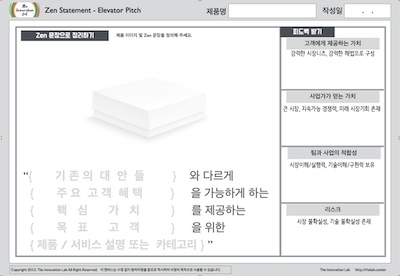
Zen Statement Definition Canvas
A canvas that clarifies a product or service concept by distilling it into one core sentence. The sentence can then support various tasks, including the concept's elevator pitch, customer feedback, and assessments of marketability and risk.
Consider the following when writing each element of the sentence.
Existing alternatives— Define broadly the competing options that customers view as alternatives.
Primary customer benefit— State the distinctive and useful benefit your product provides customers.
Core value— State the value that differentiates your product.
Target customer— Segment and narrow the target customer rather than generalizing.
Product or service description (or category)— State the category that defines the product.
Examples
Steemit
“A coin-economy-based blogging platform for professional contributors that, unlike existing blogging platforms, provides an incentive structure allowing content creators to earn revenue”
Amazon Go
“A next-generation shopping mall for busy shoppers that, unlike conventional convenience stores or supermarkets, provides automatic recognition and payment technology so customers do not have to queue at checkout after shopping”
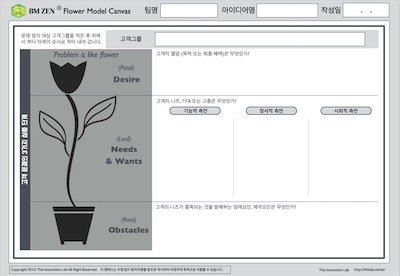
Customer Problem Definition (Flower Model) Canvas
A customer problem definition tool that examines the problems of a specific customer group beyond surface-level inconvenience, using three layers: aspirations in the petals; functional, emotional, and social needs and expectations in the leaves; and barriers in the roots.
Enter the specific customer group whose problems you want to explore. Include the customer's situation, the products or services currently used, and any observations or interview findings. Use this tool to clearly define the change customers ultimately want and the underlying problem structure, rather than rushing to propose solutions.
Reading the customer problem structure as a flower
Petal — Aspiration: Define the customer's objective and the ultimate benefit they want to achieve.
Leaf — Needs and expectations: Specify functional, emotional, and social needs and expectations, along with current pain points.
Root — Barriers: Identify the structural, behavioral, and environmental constraints preventing those needs from being met.
Analysis sequence
Specify the customer group whose problems you will explore.
Identify the aspirations and change customers ultimately want.
Specify functional, emotional, and social needs and expectations.
Identify the barriers preventing each need from being met.
Review the causal relationships among aspirations, needs and expectations, and barriers.
Write a core problem statement that can serve as the starting point for subsequent value proposition and solution design.
Core question and applications
What does the customer ultimately want to achieve, what do they need, and what prevents them from achieving it?
It can be used for customer interview analysis, new business opportunity exploration, product and service improvement, value proposition design, and customer segmentation review.
Points to note
Do not express a solution as though it were a problem. Distinguish facts confirmed through the customer's words, behavior, and context from the analyst's assumptions, and check whether the causal relationships across the three layers are supported by actual observations.
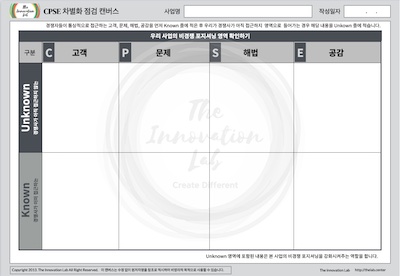
CPSE Differentiation Review Canvas
A differentiation strategy tool that compares conventional competitive approaches with untapped noncompetitive opportunities across four dimensions: Customer, Problem, Solution, and Empathy.
Enter the business, product, or service to analyze and its main competitors or industry practices. First organize the customers, problems, solutions, and empathy or frames that competitors already address in the Known area. Then use the Unknown area to explore noncustomers and problems the industry has overlooked, innovative solutions, and entirely different perspectives.
Customer · UnknownNoncustomers excluded from competition or not yet viewed as customers
Problem · KnownProblems the industry has conventionally defined and addressed
Problem · UnknownProblems not previously addressed or newly defined through a shift in perspective
Solution · KnownFamiliar market features, products, and conventional solutions
Solution · UnknownInnovative solutions that deliver a fivefold increase in value or a fivefold reduction in cost
Empathy · KnownDominant forms of empathy and frames for viewing customers and the business
Empathy · UnknownA new perspective that changes the meaning of the business and how customers are viewed
Review sequence
Specify the subject of analysis and major competitors or industry practices.
Organize the Known area for Customer, Problem, Solution, and Empathy.
Explore Unknown candidates overlooked by the industry on each dimension.
Confirm that the differences across the four dimensions connect into a single noncompetitive positioning rather than separate ideas.
Derive a strategic hypothesis that is difficult to imitate and the highest-priority validation tasks.
Outputs
Go beyond simple feature differences to create differentiated strategy candidates that connect noncustomers, redefined problems, a leap in value or dramatic cost reduction, and new empathy and perspectives.
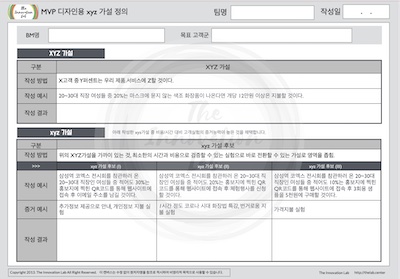
MVP Design Canvas
A canvas that turns the core hypotheses of a product or service into the smallest executable unit and provides an at-a-glance design of the value and features that must be validated, the experiment method, and learning criteria.
Use it before building the finished product to clarify the core value to offer customers and the hypothesis to validate, then design the minimum viable product and experiment capable of testing them.
Design sequence
Specify the customer, problem, and value hypotheses that must be tested first.
Define the minimum scope of features and experience required to validate the hypothesis.
Design the experiment method and channel for observing real customer responses.
Define measurement criteria for judging success and failure in advance.
Based on experiment results, determine what to keep, revise, or discard and identify the next learning task.
Core principle
An MVP is not a finished product with fewer features; it is a learning tool for validating the most important uncertainty as quickly and economically as possible.
Business Model Map
A bridge tool that transfers and develops what was defined in the ZEN Design stage into the nine building blocks of the Osterwalder Business Model Canvas. Used with service scenarios, service blueprints, and prototyping, it converts planning into a concrete execution process.
Blue Ocean Strategy includes a new-market creation strategy that turns noncustomers into customers and a differentiation strategy that uses a value canvas to build a unique value proposition distinct from competitors. Used in the ZEN Idea stage, it helps define new customers and their problems.
Participatory customer observation techniques from service design methodology help uncover hidden customer needs. A user journey map tracks positive and negative customer experiences at every touchpoint to identify problems.
To develop what was defined in the ZEN Design stage, transfer it to the nine building blocks of the Osterwalder Business Model Canvas and fill any gaps. Service-related concepts can be made more concrete by developing service scenarios, service blueprints (processes including the back end), and prototypes together.
In the execution stage (Zen Action), the cyclical process of opportunity discovery → idea generation → execution and testing → learning and pivoting is developed through Lean Startup concepts. One central concept is the MVP (Minimum Viable Product)—a minimum-feature product for market testing whether a market exists and recognizes the value. The core approach is to measure market response to the MVP, validate hypotheses, and rapidly adjust the business model.
Play guide
Place the Business Model ZEN Canvas on the table.
Decide which element to design, then identify the corresponding method (Blue Ocean, service design, or Lean Startup).
These methods can be used together and in the established sequence as needed.
A canvas for exploring the essence of a business while preserving simplicity, balance, and wholeness. It simplifies core business strategy and planning to a single page while maintaining strategic focus and a diagnostic process, connecting the concept stage, business model design, and strategic feedback. It is The Innovation Lab's most extensively documented methodology asset, encompassing a book, canvas revisions, inclusion in a national textbook, international feedback, and three cohorts of the Masterclass.
Good business always rests on a good concept. We turn the concept into a plan and realize that plan through execution. Of concept, plan, and execution, what is the common business model framework for? It is most likely for planning, because a business model is a type of plan in which core business components are selected and then configured. Yet business success requiresA good business concept · A plan for shaping the concept · Execution that realizes the plan, and all three areas must be in harmony. A business plan only shapes an existing concept; it cannot beautify an unattractive concept or improve poor execution capabilities.
Consider a good business concept as a gem. The actual gemstone is the business concept, the jewelry design is the business plan, and the craftsmanship is business execution.
Business Model ZEN design principles
Business Model ZEN's primary objective is to integrate three fundamental principles to create a successful business, but what makes the model truly distinctive is the four-stage foundational concept below.
1 · Concept Stage — A customer-centered approach to business
Take a customer–problem–solution–market perspective. A concept begins with the customer at the center of the business. Putting on the customer's shoes and glasses rather than the supplier's reveals things otherwise unseen. Customer observation has become an increasing focus in marketing because discovering latent needs through customer feedback can lead directly to successful differentiation. Supplier-centered product expansion no longer produces success as reliably as before. Still, a customer-centered view is not always a success factor; conceptualization generally needs to be expressed in the form of customer–problem–solution–market. This approach has a clear advantage: items are easier to revise as the business progresses. The customer–problem–solution–market framework is the most fundamental concept in Business Model ZEN.
2 · Planning Stage — Simplify to one page while maintaining strategic focus
Writing the core business strategy and plan takes no more than a single page, not a complete business plan. Companies increasingly note that massive reports often affect business efficiency and time to market, and some permit only one-page or oral reports. Business Model Canvas variants help simplify core business components onto a single page. At the same time, maintaining strategic focus within that simplicity is essential: simply developing a concept into a plan is unlikely to achieve the objective, so the process must be reviewed and diagnosed from a strategic perspective.
3 · Execution Stage — Measure the gap between concept and reality with a loop-learning mechanism
An effective framework is needed to support feedback on the concept, and knowledge acquired during execution must feed back into the plan. No concept is born successful, and no plan can be perfect. Only execution proves the concept and practice improves the plan. An “execution learning manual” is therefore as important as a business plan, though few companies have one. Business Model ZEN also serves as this execution learning manual: business execution must feed back into the original concept and plan to complete a looped execution mechanism that revises both.
4 · Exit (Business Success) Stage — Close the gap between market and solution
Business success does not mean achieving the financial targets stated in a business plan. Those numbers are often based on inaccurate assumptions and are therefore not a valid measure of success. In fact, a business succeeds when the gap between the actual market and the company's solution disappears, which can also mean crossing from early adopters to the early-majority market. In the majority market, concept, plan, and execution must be perfectly aligned with appropriate integrity, and the loop-learning mechanism must operate without disruption. The right market exists for a concept that solves an important customer problem, and profits follow as a result—this is a way of measuring success that treats profit as a by-product. Conversely, a profitable business lacking integrity cannot enter the majority market and remains vulnerable to crisis at any time, so profit alone cannot constitute success.
A mirroring canvas for an initial business model diagnosis. After designing a preliminary business model with the ZEN Canvas, diagnose each block in numbered order and identify strengths and weaknesses using criteria such as the number of customers and the importance of customer problems. It supports both group workshops and in-depth Excel-based analysis.
Before diagnosing the model, we recommend designing a preliminary business model with the Business Model ZEN Canvas. Diagnose each block one at a time in numbered order —Blue(upper right, healthy) ·Green(other corners, some review needed) ·Red(lower left, at risk). Falling into the risk zone during assessment signals that the business model must be reviewed and redesigned. Benchmarks are adjusted to the target business's scale, industry, and domain (for example, 10 million customers on the X-axis for a large company and 1 million for a startup). This can be conducted either as a group workshop or as in-depth analysis using an Excel sheet.
Mirror the current business model
Customer— Are the mission and actual customer and value aligned? X-axis: consistency between mission and customer value / Y-axis: consistency between mission and target customer
Problem— Is the aggregate customer problem sufficiently large? X-axis: number of customers / Y-axis: importance of the issue per customer
Solution— How different is the solution? X-axis: degree of market competition around the customer problem / Y-axis: degree of solution differentiation
Empathy— Is the level of customer empathy sufficient? X-axis: empathy with the customer problem / Y-axis: empathy with the customer solution
Collaborator— Is the potential for collaboration high? X-axis: ease of collaboration / Y-axis: collaborator's potential for an independent business model
Revenue model (revenue/cost)— Is an early return on investment possible? X-axis: initial investment cost / Y-axis: time to recoup the investment
A checklist containing the questions needed for business design, used to review what must be considered and asked in each major area. After designing a model with the BM ZEN Canvas, use it to inspect each block one at a time.
Co-developed by Alexander Osterwalder and Yves Pigneur, this canvas is a standard business model design tool that maps how a business works and how its nine blocks—customer segments, value propositions, channels, customer relationships, revenue streams, key resources, key activities, key partnerships, and cost structure—connect at a glance.
The Business Model Canvas was co-developed by Alexander Osterwalder and Yves Pigneur and became widely known through the book Business Model Generation. It is a strategic management and entrepreneurship tool that uses a single-page shared language to visualize how an organization creates and delivers value to customers and generates revenue in the process.
It can be used not only to develop new business ideas, but also to explain an existing business model, identify differences in perspective among team members, design alternatives, and discuss possible pivots. The key is to look beyond filling in each block separately and determine whether the customer, value, operations, and financial structures form one coherent logic.
9 core blocks
Customer segments
Value propositions
Channels
Customer relationships
Revenue streams
Key resources
Key activities
Key partnerships
Cost structure
Completion guide
First, clearly define the customer segments the business is intended to serve.
Write the value proposition for each customer based on the problem they are trying to solve and the outcome they expect.
Connect the channels that deliver value with the customer relationships that sustain engagement.
Identify how customers pay and the main revenue streams.
Outline the key resources, key activities, and key partnerships required to deliver the value proposition.
List the main operating costs and assess the revenue model and sustainability together.
Review the connections between blocks and mark claims with weak evidence as hypotheses to be validated.
The canvas is not a finished business plan; it is a working tool for sharing and validating current hypotheses. Update it whenever customer interviews, market experiments, or revenue and cost data provide new evidence.
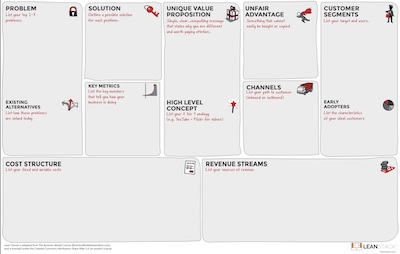
Ash Maurya developed this tool by adapting the Business Model Canvas for early-stage startups and the validation of new ventures under high uncertainty. It organizes a business idea's key hypotheses into nine blocks: problem, customer segments, unique value proposition, solution, channels, revenue streams, cost structure, key metrics, and competitive advantage, allowing them to be validated quickly.
The Lean Canvas is a tool developed by Ash Maurya by adapting the Business Model Canvas for early-stage startups and the validation of highly uncertain new businesses. Before writing a lengthy business plan, teams can capture customer problems, proposed solutions, and the key assumptions required for the business to work on a single page and agree on what to validate first.
Rather than trying to fill in the right answers from the outset, it is important to distinguish known facts from hypotheses that have yet to be validated. Update the canvas whenever evidence emerges from customer interviews, landing pages, prototypes, pricing experiments, and other tests, progressively refining the business model.
9 core blocks
Problem
Customer segments
Unique value proposition
Solution
Channels
Revenue streams
Cost structure
Key metrics
Competitive advantage
Completion guide
Define the three customer problems you aim to solve and the most important customer segment.
Write a unique value proposition that captures in one sentence why customers should choose you.
Note the minimum solution needed to address the problem and the channels for reaching customers.
Compare revenue streams with the cost structure to determine whether the business has sound basic economics.
Identify the key metrics for assessing progress and the competitive advantage that is difficult to replicate.
Use experiments to test first the hypotheses with the weakest evidence and the greatest impact if they fail.
Visual Actionboard-V (for value hypothesis validation)
A board for planning experiments, tracking work status, and validating hypotheses about the validity of the value proposition and the existence of a market, much like SCRUM project management.
Visual Actionboard-V (for value hypothesis validation)
How can it be used?
Lean Startup has two hypotheses entrepreneurs must test. The value hypothesis asks whether you are “making something customers want,” while the growth hypothesis asks whether “a desirable virtuous cycle is on a growth trajectory.” This board supports smooth validation of the value hypothesis. Use it next to the relevant canvas after designing the business model. A printed retail version is included by default in the Innovation Solution Box in the Shop.
Play guide
First read the instructions at the lower left of the canvas.
Write the C-P (customer–problem), P-S (problem–solution), and S-E (solution–empathy) hypotheses on separate sticky notes.
Attach each sticky note in the upper-right area of the canvas.
Write the experimental method for validating each hypothesis on a sticky note and attach it in the box below.
Write the experiment's success criteria and attach them in the box below.
Move the sticky note to To-Do on the left to put the experiment into action.
Move it to Doing while in progress and Done when completed.
Write the experiment results on a sticky note and attach it in the Results area.
Interpret the results, classify the hypothesis as valid (success) or invalid (failure), and move it to the appropriate area.
Record the lessons from the experiment and proceed to a new hypothesis. Repeat until all hypotheses are valid.
Once every assumption has been validated, you have created a value proposition that can be sold.
A board that validates the presence of a virtuous growth system by organically tracking experiments and conversion status, much like AARRR and marketing funnel management.
Based on the AARRR model, this action board for validating growth hypotheses simplifies the structure from five stages toTraction · Conversion · Happifythree stages, showing how the points influence one another. It is used to manage key metrics in weekly sprints and immediately identify and improve problematic flows. We recommend first using the value hypothesis validation board (V) to test whether you are “making something customers want,” and then using this board to validate the growth hypothesis.
Play guide
Divide the growth hypothesis into assumptions across three parts: Traction, Conversion, and Happify.
Plan an experimental method for each assumption.
Set completion and success criteria for the experiment.
Attach the experiment sticky note in the To-Do area of the sprint zone.
Move it to Do and Done as its status changes.
Periodically record metric results (A/B/C/D) in the table.
Apply the results and share lessons with the team.
Determine whether the assumption has been validated; if invalidated, revise it into a new assumption.
Every process repeats in the order Traction → Conversion → Happify. Once all assumptions are validated, an organically growing positive-cycle system has been created.
Ecosystem Design Canvas (I) – Platform-Space Value Design
Design the value of a platform space through intersection-based ideation. It takes an ecosystem perspective in which customers, partners, and society all gain value.
Ecosystem Design Canvas (I) – Platform-Space Value Design
How can it be used?
Platform design can be applied across a wide range of product, business, and management contexts. At a smaller scale, two-sided market models, cross-subsidies, complement configurations, and bundling business model patterns can reconfigure the network between customers and products or services. At a larger scale, it expands into ecosystem design encompassing a company's customers, partners, complementors, and stakeholders such as communities, governments, and citizens. High-tech companies such as Apple, Facebook, Google, and Tesla, as well as low-tech companies such as TED, Li & Fung, and H&M, have grown by applying platform and ecosystem concepts to their businesses.
Five stages of platform transformation
Explore — Identify platform opportunity factors
Expand — Redefine the company's purpose and the essence of its business
Design (small scale) — Apply platform business model patterns
Design (large scale) — Ecosystem Design I
Design a virtuous cycle — Ecosystem Design II, platform classification and ecosystem value assessment, execution plan
Play guide
Enter a provisional name for the new platform space to be created.
List the people and companies you want to participate in the space. Ensure appropriate participation by both suppliers and users.
List the values exchanged through the platform space.
Review whether benefits are sufficient relative to costs from each participant's perspective and adjust as needed.
Assess whether the total value created overall is sufficiently large.
Redefine the original platform-space name if needed.
Ecosystem Design Canvas (II) – Platform Virtuous-Cycle Design
Identify platform cycles and complementary relationships to design a virtuous-cycle structure. This is the next stage after Ecosystem Design Canvas (I).
Ecosystem Design Canvas (II) – Platform Virtuous-Cycle Design
How can it be used?
A platform can be described as a strategic tool that gains substance through emptiness. A platform aspires to a model of continuous growth by leaving itself incomplete, opening communication, and being filled over time. As an “Unoccupied System” that gains competitiveness by not being completed in advance, it resembles a vessel: a vessel becomes useful because it contains empty space. A platform is also a “Link System” connecting the inside with the outside and external parties with one another.
Play guide
Enter the name of the platform space defined earlier.
Define the complements and derivative goods that platform participants will voluntarily create to increase ecosystem value.
Place each item in the appropriate section according to the predictability of its outcome and the actor responsible.
In the (+) empty-space area, enter what we must provide to encourage the creation of complements and derivative goods.
In the (−) empty-space area, enter what we must prepare to collect and distribute complements and derivative goods.
Assess whether the virtuous flow of the platform ecosystem is clearly visible overall.
Follow the guidance on each canvas for toolkit-specific copyrights and conditions of use. PDF downloads, online editing, and AI app launch links are available directly from the cards.
04 · Proof
Case connections
Samsung Electronics B2BBusiness model patterns and the Big Biz Model perspectiveProof Library →
UL KoreaBusiness model design and cash-flow simulationProof Library →
AIDX CampAI-based business model canvas and execution roadmapProof Library →
Diagnosis of 85 GNU teamsBM HealthCheck systemProof Library →
Contact
A methodology is not an explanation—it is a field-validated tool for thinking
Find out which toolkit fits your organization's challenge and how it can be used with training and workshops.
Quickly explore The Innovation Lab’s role and methodologies from the perspective of your challenge.
Which business model canvases and AI toolkits do you offer?
We provide the Business Model Canvas (9 blocks), Lean Canvas, BM ZEN Business Design and Diagnostic Canvas, AI Business Canvas, AX Business Canvas, and tools for customer problems, value propositions, MVPs, and Lean Startup hypothesis testing, organized by purpose and stage of application.
How do I use a toolkit?
Open Explore on each card to review its purpose and guide, then use the PDF download or online editing link for your specific task. Some toolkits let you begin asking questions and running analysis immediately through the Launch AI App button.
In what settings have the public toolkits been validated?
The public toolkits are based on methodologies repeatedly applied and refined for more than ten years in corporate innovation training, workshops, coaching, and consulting.

 Explore BM ZEN