
Big Blur 2.0: How AI Is Breaking Down Industry Boundaries
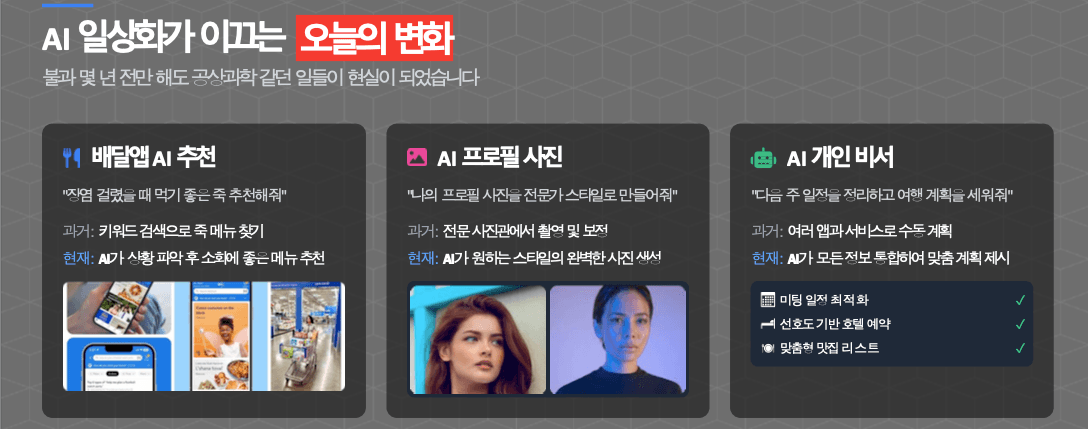
Just a few years ago, we imagined change on the scale of delivery apps replacing restaurants and AI profiles replacing photography studios. Recent developments, however, are on an entirely different level. A retail platform that recommends not only chips and drinks but even a TV in response to the single phrase “Prepare a football watch party,” an AI banker that provides investment advice to customers, and an automotive seat bracket that integrates eight parts into one, reducing weight by 40% while increasing strength by 20%. These are signals that the “Big Blur” phenomenon—the blurring of boundaries between industries and services—has met a new engine in generative AI and entered the era of “Big Blur 2.0.”
Big Blur 1.0: New Market Rules Designed by Platforms
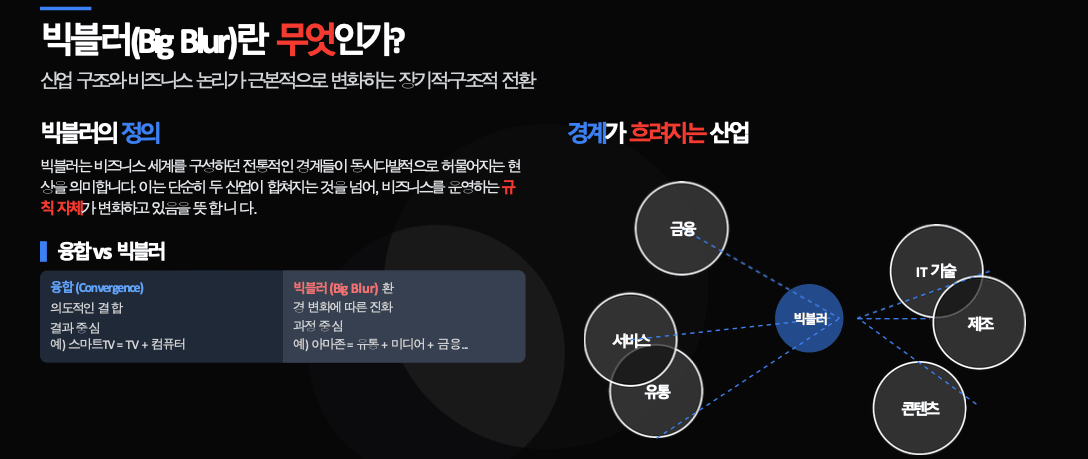
To understand the disruptive power of Big Blur 2.0, we must first examine the foundation built over the past decade by “Big Blur 1.0,” led by mobile technology and platforms. This period redefined the fundamental rules of business.
Consumers were elevated from mere buyers to “Key Activists” who participate in corporate activities, and companies shifted their focus from one-off “Transactions” to ongoing “Relationships” with customers. Rather than following established markets, late entrants had to “Redefine” markets themselves and create differentiated value to survive. KakaoBank, which lowered barriers to finance through IT, and convenience stores, which became lifestyle hubs encompassing delivery and financial services, are representative examples. “Transcending” industry boundaries thus became the default, while the unit of competition expanded from individual companies to contests between “Ecosystems” that include partnerships.
Big Blur 2.0: “Generation” Reshapes the Value Chain
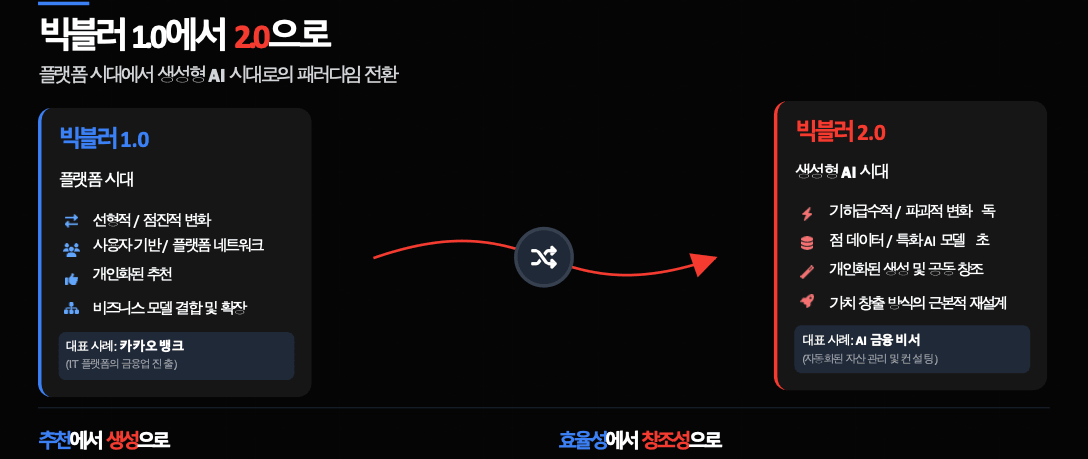
If Big Blur 1.0 was an era of “recommending” optimal answers based on past data, Big Blur 2.0 is an era of “generating” new value tailored to customer needs through generative AI. This goes beyond technological progress and represents a more fundamental and disruptive change that reshapes the industry value chain itself.
French retailer Carrefour’s AI assistant “Hopla” builds shopping baskets and suggests recipes based on customers’ budgets and diets, expanding the grocery store’s role into those of a nutritionist and chef. The “AI bankers” at Shinhan Bank and KB Kookmin Bank are democratizing sophisticated wealth-management services once reserved for private-banking clients, breaking down the boundary between self-service apps and professional consultants. GM’s generative design has dissolved the boundaries between human imagination and machine productivity, and between design and engineering, while the AI writing service “Wrtn” has demonstrated that AI can become a platform for creativity rather than merely a tool by producing everything from advertising copy to business plans.
Talent for the AI Era: Proposing the “Echelon Model”
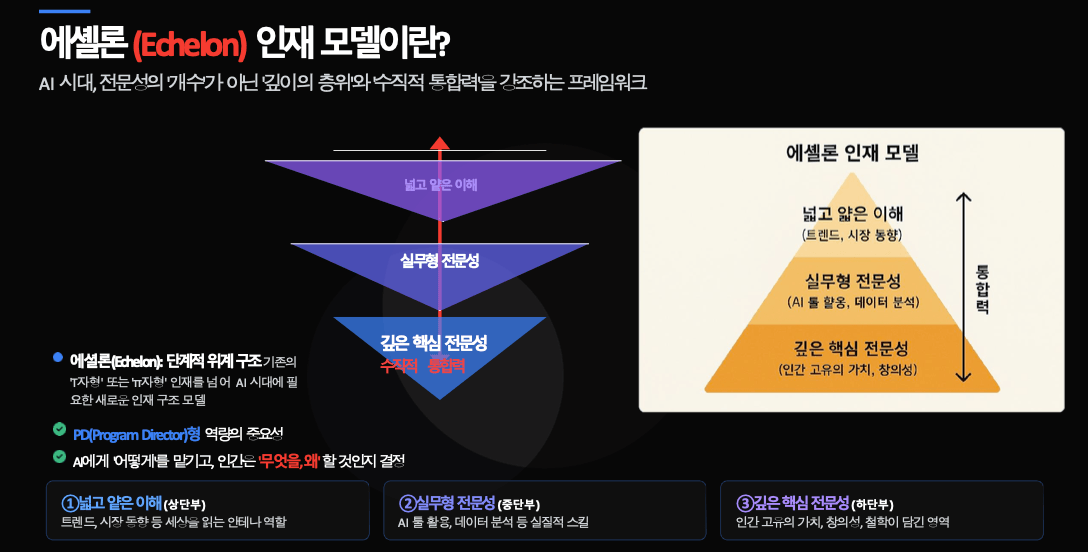
As AI rapidly replaces the functional roles of humans, what capabilities should individuals and organizations develop? As an answer, I propose the “Echelon Talent Model,” which emphasizes the “depth” of expertise and the ability to achieve “vertical integration.”
The Echelon Model consists of three layers of expertise. The top layer is “broad and shallow understanding,” serving as an antenna for reading trends and market movements. The middle layer is “practical expertise,” meaning applied skills such as using specific AI tools or analyzing data. The bottom layer is “deep core expertise,” the domain containing uniquely human philosophy and creativity that AI cannot replace.
The heart of this model, however, lies in the “Vertical Integration” that runs through all three horizontal axes. It resembles the capabilities of a “PD (Program Director),” encompassing planning, coordination, and leadership. In other words, it is the ability to entrust AI with the “How” while humans define and question the “What” and “Why.”
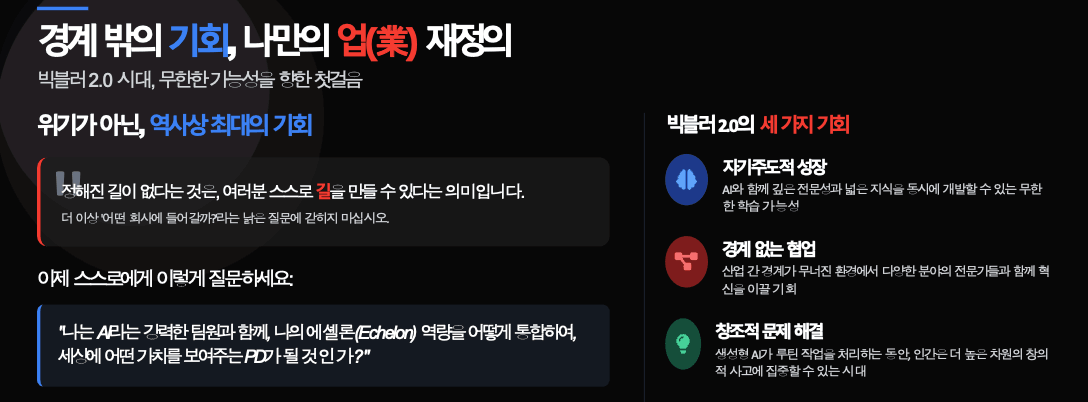
When the boundaries of the world disappear, there is no prescribed path—which also means we can forge our own. The future will be an era of “autonomous AI agents” that set and execute their own goals. In this environment, the human role must evolve into that of a “strategist” and “director” who commands and oversees AI. It is time for individuals and organizations to abandon the old question, “Which company (industry) should I belong to?” and answer a new one: “How will I integrate my capabilities with AI as a powerful team member, and become a PD who demonstrates value to the world?” The greatest boundary may lie within us.
This column has been adapted from the key content of a recent lecture for young people titled “Why Is Convergent Thinking Necessary in an Era Without Boundaries?” The presentation materials from the lecture are also shared to help readers visually understand major concepts introduced here, including the “Echelon Talent Model.”