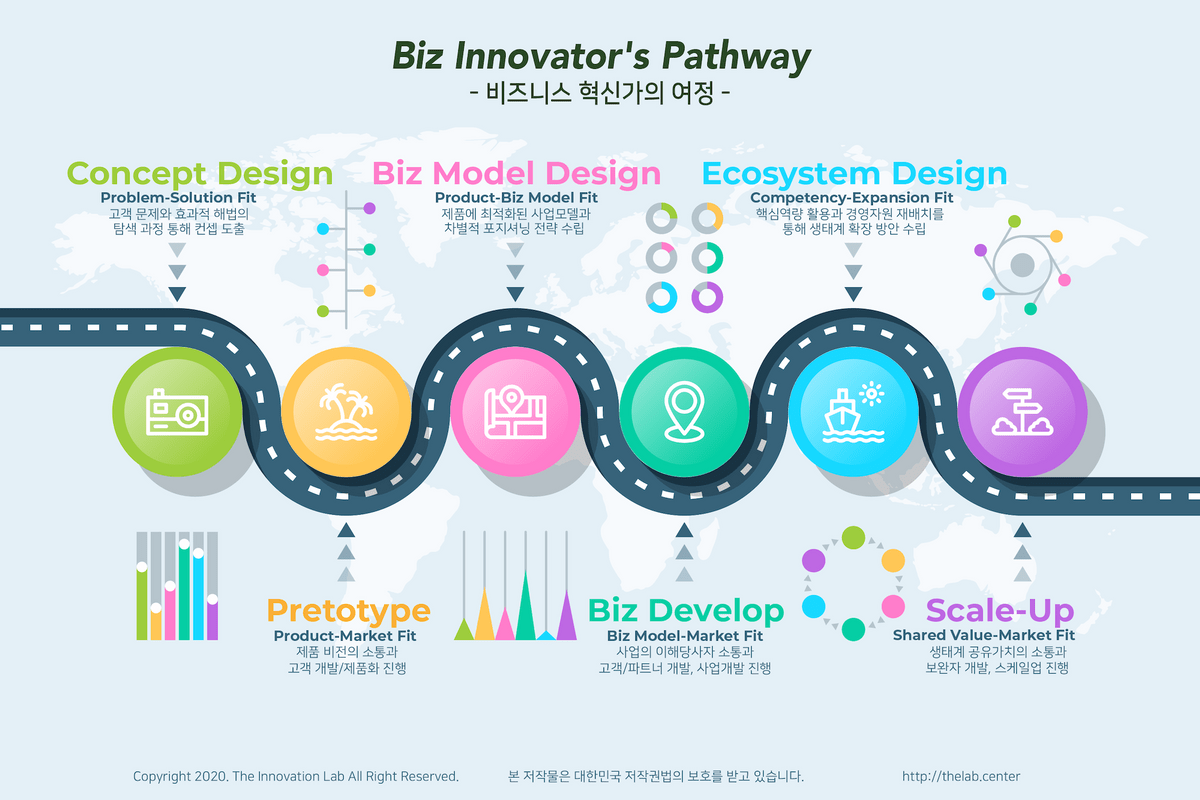
Download the high-resolution PDF
It is a good time to set the magic ball rolling.
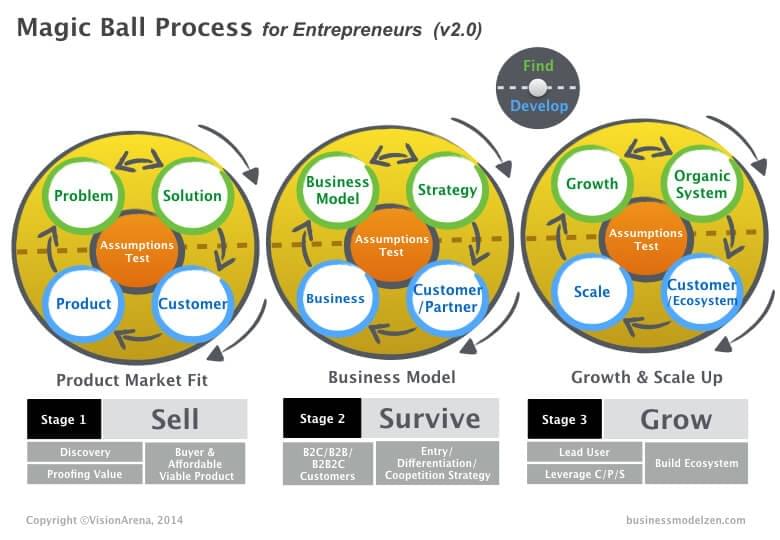
Innovators and entrepreneurs do not think and act linearly. They understand the value of repeated validated learning through hypothesis testing and of exponential growth. The Magic Ball Process (Magic Ball Process) helps people move beyond outdated waterfall (Water Fall) or linear approaches by presenting stages for selling, surviving, and growing through iterative learning and hypothesis validation.
This process was developed from insights gained over more than 10 years of working with numerous startups and corporate clients through workshops, coaching, consulting, and running learning organizations. On January 26, 2018, it wasfirst published in Englishand was then translated into Korean and posted on the website
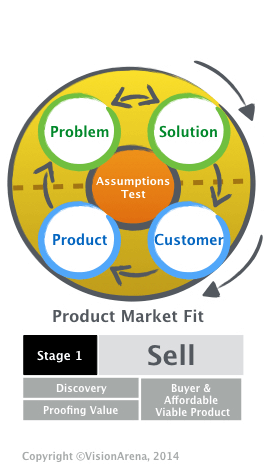
Stage 1. Sell (Product-Market Fit) Stage-I. Sell (Product-Market Fit)
- In this first stage, a startup’s discovery objective is to identify a major customer problem and an effective solution idea for addressing it. Its development objective is to acquire paying customers with a sellable prototype such as an MVP (minimum viable product).
- Develop paying customers in advance, then develop the product. There is no need to create a perfect solution all at once. It is better to have an evolving product. This can therefore be done with an MVP (minimum viable product) and an AVP (affordable viable product). MVP is a widely known concept meaning a sellable prototype or a vision for the product. An AVP is a product for sale that reflects affordable production, development, and sales capabilities. It is a stepping-stone product for generating initial revenue before creating the final, fully realized product you envision.
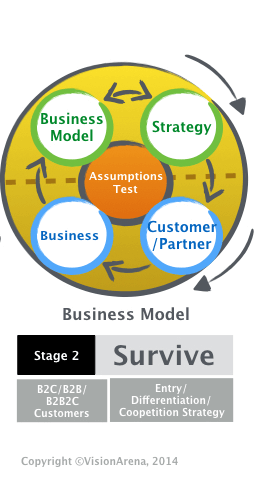
Stage 2. Survive (Business Model) Stage-II. Survive (Business Model)
- In this second stage, a startup’s discovery objective is to design a business model supported by an effective strategy. Its development objective is to establish a sustainable business by strengthening customer relationships and long-term partnerships.
- Long-term partners and a profit formula that can address sustainability issues must be considered alongside business development. An in-depth analysis of the industry is required to find ways to differentiate the company from strategic groups within its industry.
- The initial target can be expanded to develop adjacent markets, including B2B / B2B2C customers.
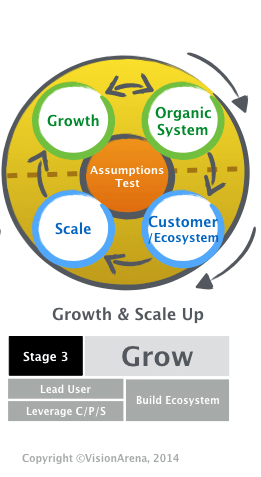
Stage 3. Grow (Scale Up) Stage-III. Grow (Growth & Scale Up)
- In this third stage, a startup’s discovery objective is to strengthen its growth strategy on the basis of assets and core capabilities already developed. The startup can redefine the world around it as an organic system that surrounds it. Its development objective is to build a business system that cultivates and expands existing markets and creates long-term, sustainable growth.
- New customer problems that hold the key to market creation can be discovered by observing lead users (DIY users) who modify and use a product to solve other new problems, or by identifying opportunities arising from specialized requirements.
- An ecosystem perspective can be adopted to go farther together with partners.
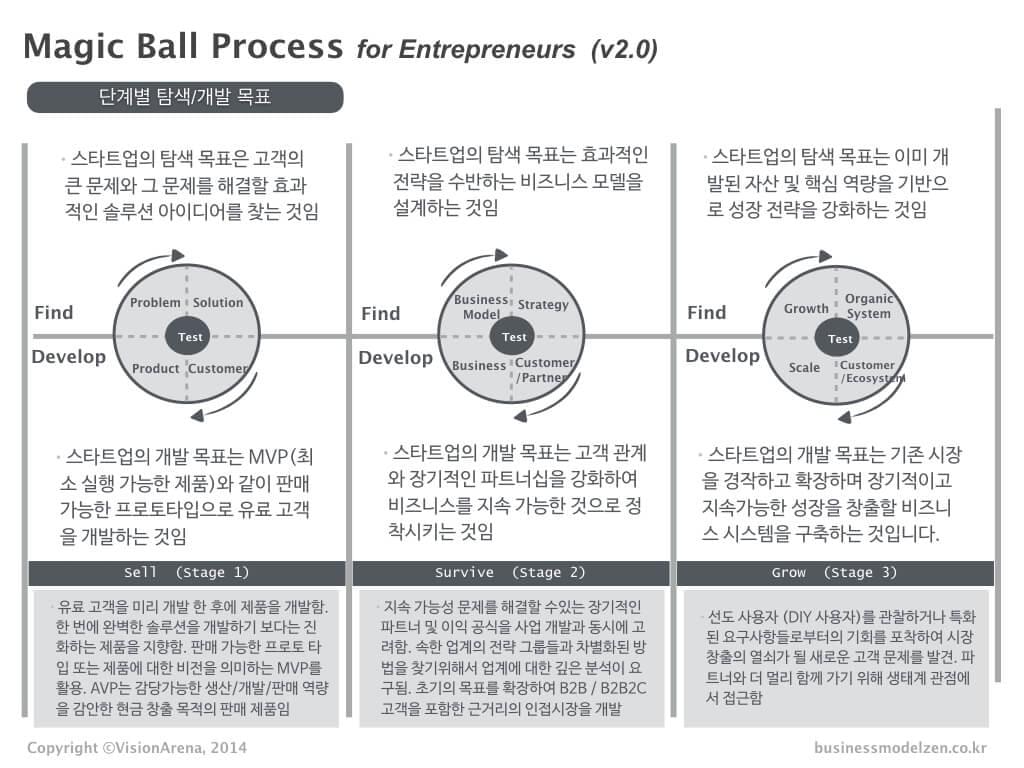
Which ball am I holding now? Sometimes you may be holding two or more balls. What matters is that, at this moment, one of them is the ball on which you should focus in particular. To better understand this process, you may find it helpful to read the illustrative case study‘From Starting in a Kitchen to Being Acquired by Coca-Cola’post.
Now, set your own magic ball rolling.