Written by Yongho Cho of Vision Arena
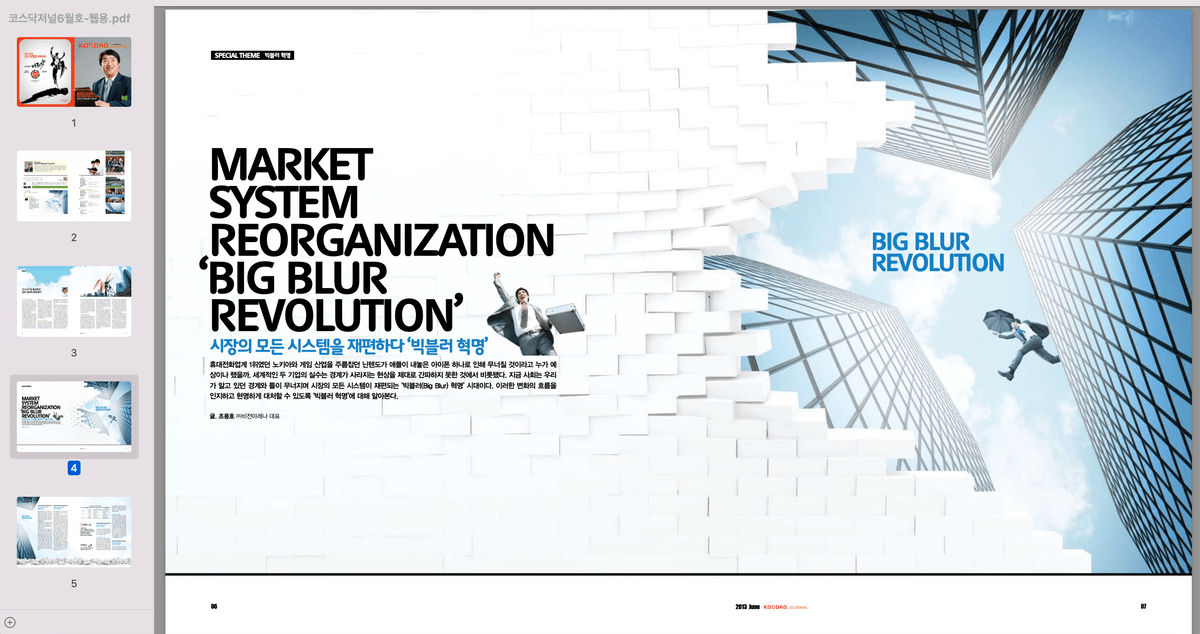
‘Big Blur Revolution’,
Reshaping Every System in the Market
Throughout history, eras of exceptionally intense social and cultural change have shared one characteristic: boundaries that had previously been clear disappeared, and things once distinct and separate went through a process of intermingling.
The Renaissance, the event separating the Middle Ages from the modern era, blossomed as European and Arab scientists, artists, and others interacted around Florence.
The Industrial Revolution, which separates the modern era from contemporary industrial society, likewise began when Britain, having suffered the least damage in the wars waged by Napoleon, grew rapidly as a maritime power and became a center of trade between East and West. Soaring demand for processing cotton textiles imported from the colonies triggered mechanization. As boundaries disappeared, foundational technological innovations that spread change—such as Gutenberg’s printing press and the invention of the steam engine—emerged, further accelerating their disappearance.
These days, we have once again entered an era in which boundaries are disappearing. These changes unfolding around us will have a major impact on the future. Before examining them, let us briefly define “boundary dissolution.” Many related terms exist, including convergence, fusion, and hybridization.
The conventional concept of convergence developed largely from an outcome-oriented perspective focused on creating new products or businesses. Boundary dissolution instead focuses on the process by which major boundaries in business are disappearing. Things once considered clearly different gradually grow alike. This is becoming a defining current of the times. I will refer to this phenomenon collectively as a new revolution that erases the boundary lines of business: the Big Blur Revolution.
Alongside recent technological innovations such as smartphones, several social changes are simultaneously driving this current.
First, population aging is expected to increase the number of people who struggle to generate steady cash flow. This reduces individuals’ appetite for active investment and leads to more conservative asset management. Recession and low growth have become entrenched since the financial crises in the United States and Europe, depressing consumption worldwide and making companies reluctant to invest in facilities.
In the international community, leadership centered on major powers is also weakening as the world becomes multipolar. Companies now concentrate on uncovering needs hidden in individual minds rather than treating consumers as a mass.
In customer engagement, mass customization and satisfying the desire for personalization are emerging as differentiators. Smartphones and social networks have brought a hyperconnected society in which people are always reachable and information and individuals worldwide are connected in real time. As environmental issues such as global warming rise in prominence, consumers are also increasingly demanding that companies create social value in addition to profitability and employment.
The changes brought by the boundary-erasing Big Blur Revolution can be grouped into six categories. Consumer participation and relationship-based business are increasing in corporate activity. Within intercompany value chains, servitization and clashes between business models are growing. Industry boundaries are being dismantled, while smartphones are accelerating the formation of digital ecosystems.
| Category | Detailed item | Past | Big Blur era |
|---|---|---|---|
| Corporate activity | Consumer role | Product purchasing, limited support for corporate activities |
Participation in key areas of corporate activity |
| Corporate focus | Transactions with customers | Ongoing relationships with customers | |
| Value chain | Role of services | Customer-service function | Sustainable growth model |
| Business model | Same market, similar value and approach | Market redefinition, differentiated value and approach | |
| Industry | Industry barriers | Distinctive roles exist | Transcending industry boundaries |
| Scope of competition | Between individual companies and value chains | Expanded around ecosystems |
Comparison of key differences before and after the era of boundary dissolution
Taken together, these changes show that in the Big Blur Revolution era, boundaries are disappearing chiefly between buyers and sellers, small and large, and tangible and intangible. Here are several concrete examples.
Consumers and companies are increasingly communicating and pursuing development through long-term relationships rather than one-off transactions. Community-based collaboration and human interaction are erasing the once-clear boundary between consumers and companies.
The Age of Consumer Collaboration—Inventing a Bicycle in One Day, Something Even IDEO Could Not Do
IDEO, a design consultancy recognized as one of the world’s most creative groups of professionals, once attracted attention by showing on the US network ABC how it redesigned and prototyped an in-store shopping cart. About 20 top professionals spent five days on the project. Could an entirely new bicycle be designed and produced in just one day with help from the general public?
A US company called Quirky actually completed this difficult mission. Quirky turns people’s invention ideas into real products and has a community of more than 230,000 members. Broadcasting live through SundanceTV, it asked people to submit bicycle ideas. About 800 people participated in a single day, and Quirky successfully turned the selected idea into a prototype bicycle. It designed the bicycle on a computer, immediately printed the parts with a 3D printer, and assembled them. By connecting a broad crowd of consumers, it achieved results far superior to those of the industry’s best expert group.
This means consumer collaboration has expanded the horizon of what companies can do beyond imagination.
The Conversational Company—Zappos Encourages Small Talk with Customers
Both TOMS, known for one-for-one marketing, and Zappos, sold to Amazon for KRW 1.2 trillion, are online shoe retailers that also represent relationship-based business. Zappos in particular says, “We are a customer-service company that just happens to sell shoes.” It therefore makes extensive efforts to delight customers and build close human connections. At other companies, separate call centers measure performance by how many calls their agents handle each day.
At Zappos, most employees are accustomed to taking customer calls, and what matters is not how many calls they process but whether even a single customer receives the highest level of satisfaction. They kindly answer customers who ask where to find a nearby pizza restaurant, and employees sometimes even offer life advice. Zappos is not merely a shoe company but one that “delivers happiness”—so much so that Amazon CEO Jeff Bezos said he wanted to buy its culture. Relationships rather than transactions in the traditional sense are becoming central to future competitiveness.
The next disappearing boundary is the distinction between small and large. Collective-content licenses are making many things free, while more catalyst companies are emerging to support individuals and small businesses. Sharing-economy companies are also creating a world of Micro Entrepreneurs, in which individuals can briefly act as entrepreneurs.
Small Giants—Just 100 People Power 17 Percent of the Global Web
A photography-loving blogger began a project that became Automattic, a company with only about 100 employees. The company is famous for WordPress, the website software it created.
More than 17% of all websites worldwide are now built with it. Such a tiny workforce achieved this remarkable feat by making the software open source and developing it collaboratively with developers around the world. Going a step further, WordPress was placed under a nonprofit foundation, effectively dedicating it to the continued development of the internet. Automattic instead earns revenue through premium WordPress-related services and outsourced operations.
A simple hobby project begun by one blogger captured worldwide attention and created a domain that no internet giant can now challenge.
Here is another example. Crowdfunding is a method by which many people jointly invest in works of art, product development, and other projects. Kickstarter is a US company famous for this model and has continued to grow rapidly. As of 2012, the total amount invested in fields such as the arts through Kickstarter exceeded the budget of the US National Endowment for the Arts. Private-sector investment surpassed government funding. WordPress and Kickstarter are catalysts, playing a powerful role in improving society-wide efficiency by connecting people.
The Rise of the Sharing Economy—Airbnb Surpasses the Hilton Group in Annual Guest Nights
The hotel company with the most rooms worldwide is the famous Hilton. Recently, however, Airbnb surpassed Hilton’s room count. Airbnb enables individuals to rent their spare rooms or spaces to others. Listings on the site include a room, a corner of a living room, a treehouse, an igloo, and a luxury vacation home.
Its defining feature is that transactions occur through horizontal relationships. Hosts can choose which guests to accept, and hosts and guests can rate one another. It is a classic reputation-based community marketplace. In the sharing economy, people rent out their assets, meet and transact with one another, and may become friends in the process, creating a new economic model.
Finally, the boundary between the tangible and intangible is disappearing. This means rediscovering intangible services, while the boundaries between offline and online and between information and physical objects grow indistinct.
Service Inside—Service Is Now Both the Preservative and the Soul of a Product
Cemex, a leading Mexican company, is the world’s third-largest cement producer. Many people in Mexico lived in shacks rather than proper homes because they lacked construction materials such as cement and gravel.
To help stabilize housing for these people while addressing its largest market, Cemex operates a program called Patrimonio Hoy. It groups people through a system similar to a Korean rotating savings club. Participants pay a fixed sum each month, and when their turn comes, cement, sand, gravel, and other materials are delivered to where they live.
This has greatly increased the number of people living in proper homes in Mexico. Building on its success, similar programs have begun to appear in developing countries. More than 200 million people are reportedly beneficiaries. This is an example of a cement manufacturer providing financial services to people with low incomes. Services also keep products from becoming commodities and allow them to remain fresh.
Online–Offline Dissolution—The World of the Internet of Things, 3D Printers, and Augmented Reality
Through augmented reality and 3D printers, content can now emerge into the physical world, and designs that existed only as information can be printed directly as tangible objects. Boston Consulting Group once forecast that by 2020, 10–30 percent of transportation, computer, metal, and machinery products would be produced at home using 3D printers.
People’s everyday lives are also changing. Even in spaces used for transportation, such as aircraft, people strongly desire to meet new friends. Dutch airline KLM operates a program called Meet&Seat. Participants can view in advance the Facebook profiles of people booked on the same flight. If they find someone with whom they would like to talk and build a friendship during the flight, they can reserve a seat beside that person. Online and offline encounters now overlap and layer upon one another.
So far, we have briefly examined several examples of change brought about by disappearing boundaries. Some companies have failed as boundaries disappeared, while others have succeeded.
Most companies placed at risk when boundaries disappear are those that established themselves through the old rules for success within those boundaries. When a boundary disappears, entirely new rules of the game take effect in the market, and the Game Changers are generally companies crossing in from outside that boundary.
Kodak, the camera-film manufacturer, already possessed digital-camera technology when it was thriving with close to an 80% share of the US market. Yet it rested on the old rules for success, surrendered the market to companies from the digital-device sector such as Sony and Samsung, and later went bankrupt.
Nintendo likewise became an innovative company and earned enormous profits from portable and motion-controlled game consoles such as the DS and Wii. Then Apple’s iPhone suddenly entered the market, and App Store games encroached on the casual-game market Nintendo had led, wiping out a substantial portion of its profits. Nokia and Sony also became complacent and fell into crisis.
The tendency to rest on established rules for success exists in every organization. Veteran managers who created those rules and witnessed them at work are especially likely to be held back by past success. Even when a newly opened boundary begins to drive change, established assumptions cause organizations to ignore or dismiss it.
An era of disappearing boundaries contains opportunity and crisis, as well as harmony and competition. How individuals and companies interpret and prepare for this situation will therefore affect their likelihood of success.
Individuals must first become tolerant of unfamiliar and heterogeneous things and actively develop creative capabilities. They need to join the Creative Middle.
Just as a society becomes more stable when its middle class, defined by wealth and income, is broad, our society can build future competitiveness when creativity becomes widespread. People should participate in activities that involve making things and occasionally live as “Micro Entrepreneurs” by using the assets they possess. As machines and information systems equipped with artificial intelligence replace more work, developing human qualities that machines find difficult to imitate will be important to success. This is why broad interest in fields such as the humanities and arts is needed.
Companies must approach consumers as parties to relationships rather than transactions. Consumers increasingly expect companies to act in human ways consistent with social values. Companies must therefore remain connected to customer communities and customers, personify themselves with sincerity, and create their own stories. They must also collaborate with consumers to transform the entire process, from product planning, R&D, and marketing to pricing and feedback.
Consumer communities now serve as a company’s vital vanguard, helping close the gap between products and markets. It is also important to embed the soul of service in the organization and anticipate the lifestyles that new technologies will create. One useful practice is to adapt the company’s mission, as Zappos does in this article, to “a customer-service company that sells OO,” and then put it into action. Finally, companies must avoid resting on established rules for success and continually reinvent themselves.
In the age of the Big Blur Revolution, it may be a grave mistake to assume that established rules for success have a long shelf life. Ultimately, an important way for a company to survive continuously in an era of disappearing boundaries is to create an environment that nurtures internal challengers capable of disrupting its current business model.
The End.