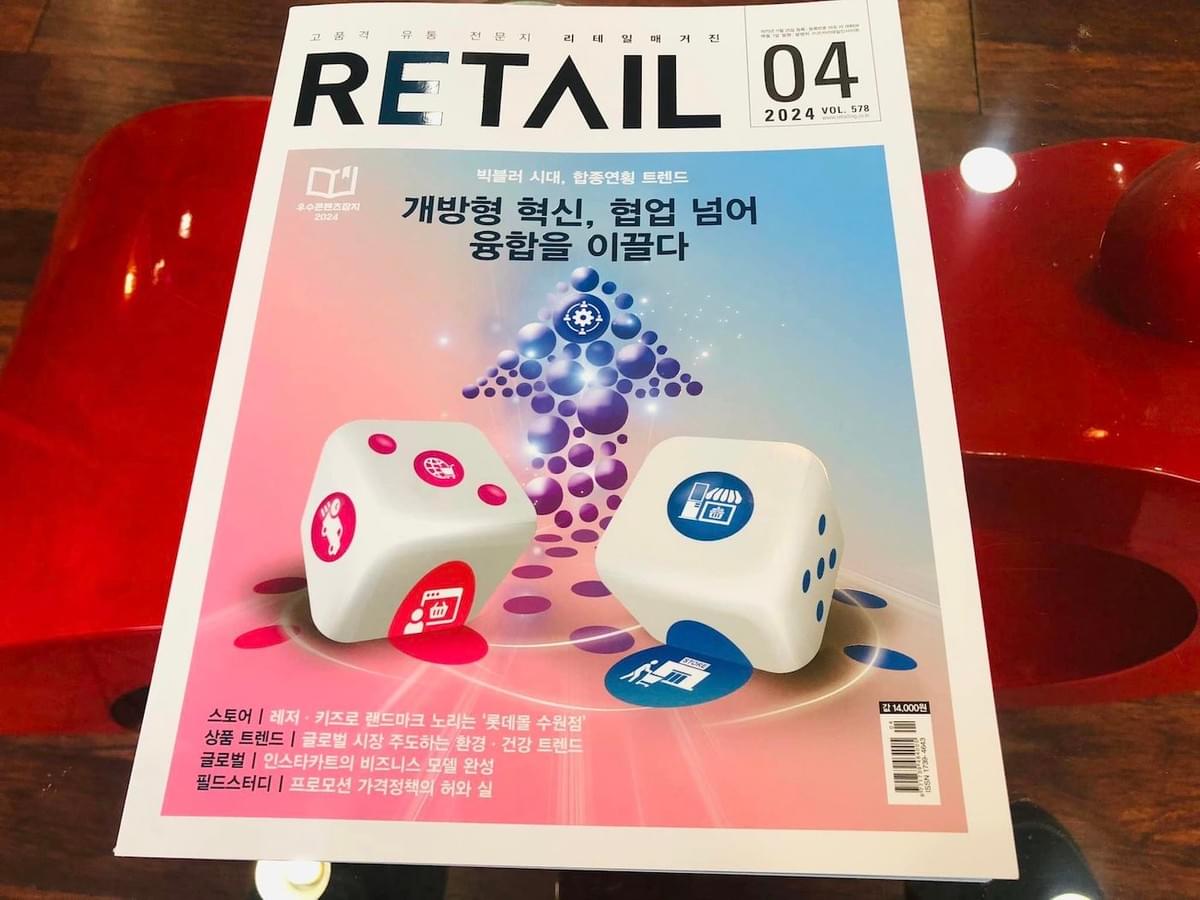
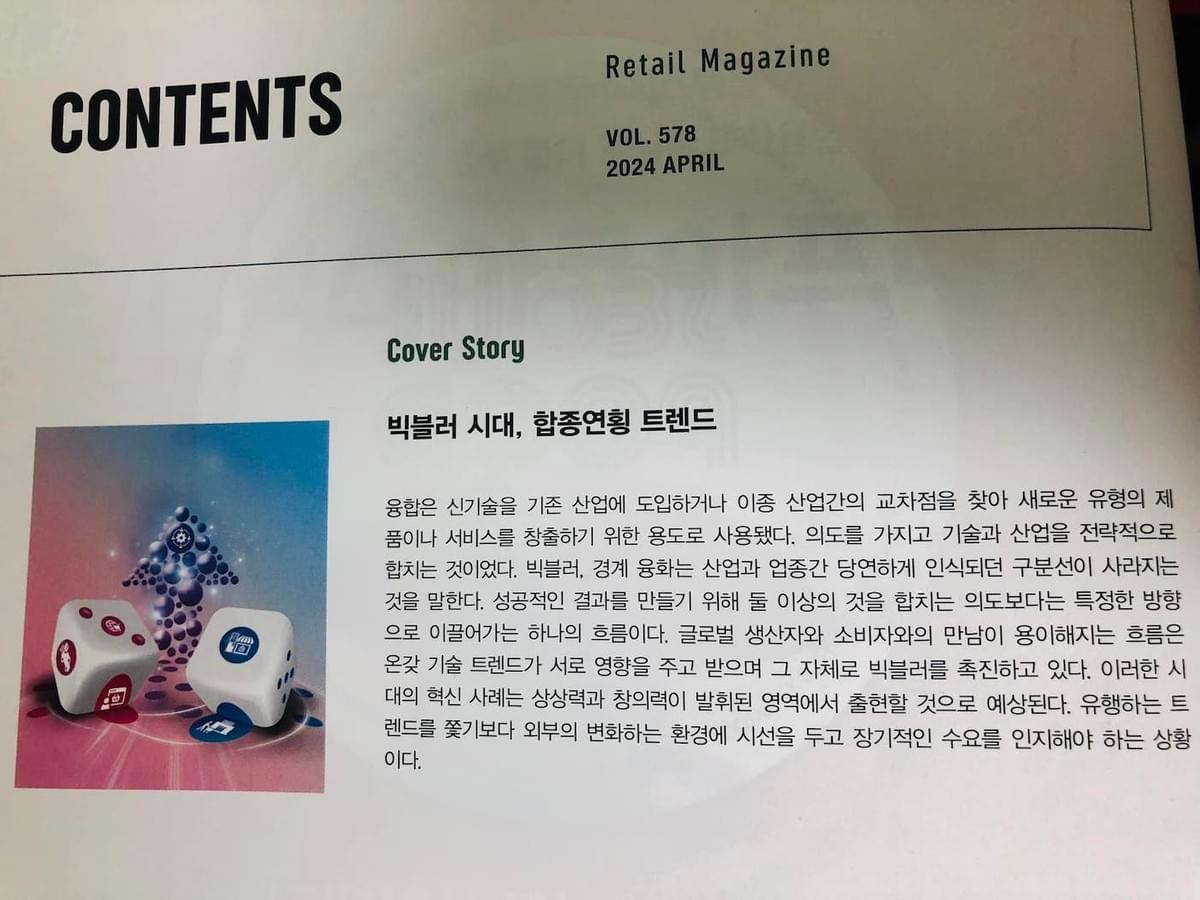
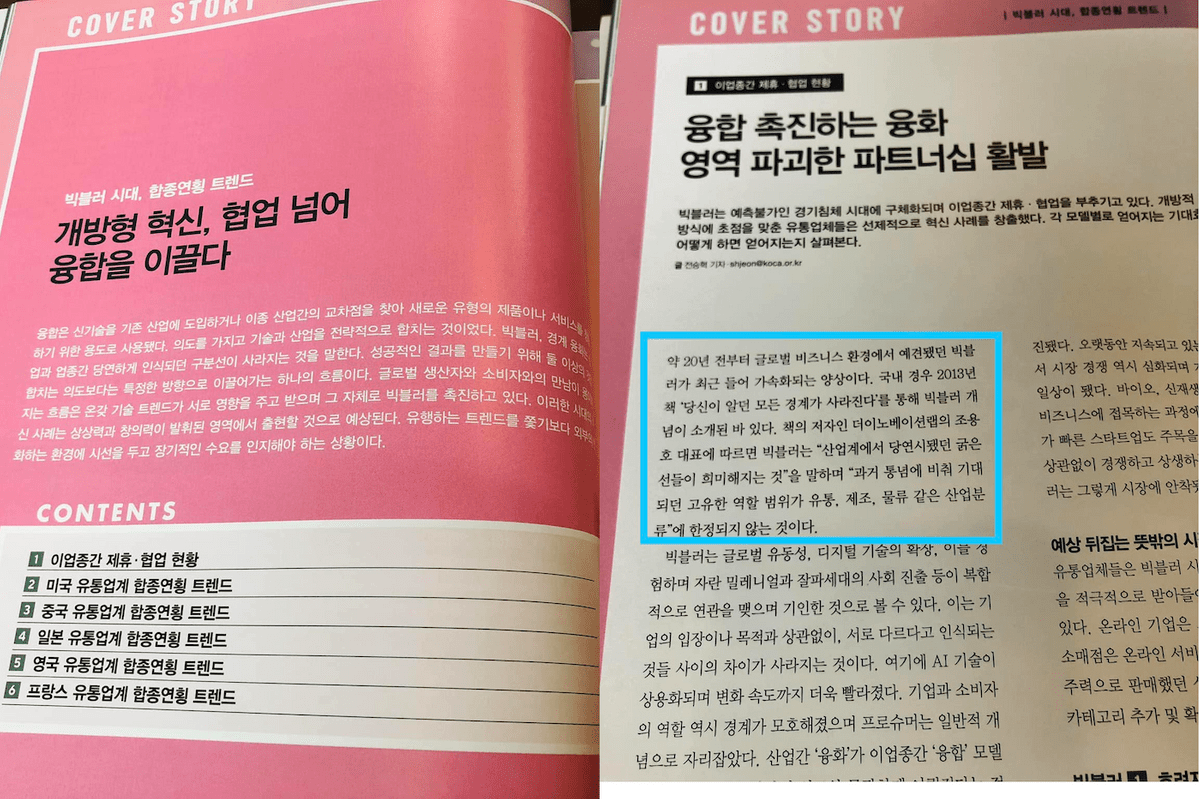
Retail Magazine, a Korean retail trade publication subscribed to by employees of major domestic retailers including hypermarkets, department stores, and convenience stores, contacted us about a Big Blur special feature it was preparing for April. This is the written interview we provided. Although only part of the content appeared in the print magazine due to space limitations, we believe it helped shape the overall framework of the special feature.
1. More than ten years have passed since you wrote the 2013 book <All the Boundaries You Knew Will Disappear> (hereafter “the book”). As someone who foresaw the Big Blur era, how have you viewed the convergence among industries over the past decade?
- When I was writing the book, Big Blur—the phenomenon of dissolving boundaries—was appearing only sporadically and in fragmented forms, and most industry leaders regarded it as an exceptional phenomenon. Ten years later, I feel it is now accepted as universal. Relevant catalysts for the changes in between have been diverse: the startup boom buoyed by abundant global liquidity; the emergence of digital assets, broadly represented by Bitcoin; the rise of Millennials and Gen Z, who embrace novel and unusual experiences; the adoption of contactless digital services across all generations due to COVID-19; and, most recently, generative AI.
- In Korea, references to Big Blur began to increase in earnest as a way to explain four key shifts in dining trends (2018) and the Financial Services Commission’s rationale for innovating regulatory oversight (2019). Discussion spread first through the food-service and financial sectors, then expanded sharply around 2020 into construction, gaming, food, energy, and retail. I have watched this development with great interest.
- These are already well-known examples, but convenience stores adding post-office, locker, and garment-care functions; Sulbing selling jajangmyeon; Kyochon selling hamburgers; and a flour manufacturer brewing and selling beer all reflect a social shift that supports and celebrates attempts to cross boundaries. During the COVID-19 era, the purpose of the home was also redefined, bringing many changes such as home fitness, home offices, and home theaters.
2. In your Dong-A Business Review column <In the Big Blur Era, Imagination Is the Engine of Innovation>, you said that “the dissolution that erases boundaries ultimately makes convergence itself easier.” Could you explain the relationship between convergence and dissolution?
- Convergence was a popular term around the turn of the 2000s. It was used mainly to describe introducing new technologies into existing industries or finding intersections between different industries to create new types of products and services. Its underlying premise is therefore an intention to examine technology and an established industry, or two different industries, and produce an outcome through convergence.
- Dissolution is perhaps the closest English term for this concept. It means that the thick lines long taken for granted between industries and business sectors are fading and disappearing. Being part of a particular industry or sector no longer allows a company to remain comfortably within the scope of roles traditionally expected of it, and competition now also crosses industry and sector boundaries. Big Blur, which recognizes and defines boundary dissolution as a megatrend, describes how multiple underlying changes accelerate the disappearance of these boundaries, and how the disappearance of one boundary creates a feedback structure in which adjacent boundaries also fade. It is therefore better understood as a current that naturally leads us in a particular direction than as an intention to generate an outcome, as convergence is.
- In summary, if convergence is like a man and a woman meeting and having a child, dissolution is closer to a man and a woman recognizing what they share and growing more alike.
3. The “underlying changes” identified in the book—“technology,” “finance,” “aging,” “the environment,” “energy,” “international hegemony,” “economic recession,” and “personalization”—have indeed brought boundary dissolution to many industries. What technological and social factors do you believe are currently accelerating the Big Blur?
- On the consumer side, values and tastes have become more important. On the producer side, inexpensive and effective tools have made experimentation easier. Factors that provide access to distribution and payment networks—and, when desired, easy connections to global consumers—also appear to accelerate the Big Blur. From this perspective, advances in fintech, the metaverse, blockchain, the subscription economy, ESG, crowdfunding, artificial intelligence, environmental and climate-change solutions, renewable energy, and many other fields are influencing one another and accelerating the Big Blur.
- Especially notable accelerators include younger generations’ short-form-driven culture of rapidly sharing unfamiliar and novel things; access to content- and knowledge-production tools through generative AI and the resulting Mass Personalization; and the NFT-based token economy, which converts tangible assets into digital assets, divides ownership, and enables their distribution.
4. “Prosumers” and “secondhand trading,” which you proposed in the book as “new points of contact,” are now established as mainstream business concepts. What new points of contact do you expect could drive business innovation in the future?
- Prosumers and secondhand trading were not entirely new concepts even when I wrote the book, but I presented them as examples to explain the disappearance of the boundary between consumers and producers. Consumers have already changed substantially from passive parties with a limited role as the object of transactions into active, participatory agents who plan, improve, and promote products and services. Companies are also maturing by communicating with customers through their brand identity and demonstrating authenticity.
- When I wrote the book, startups launched by small teams and conventional large corporations seemed so different that there was little basis for interaction. Today, under the banner of open innovation, it has become routine for large companies to learn from small ones and seek opportunities for investment and business collaboration. This is another major change. Inexpensive production tools, outstanding talent, abundant market investment, and Silicon Valley-style growth formulas have turned many startups into industry leaders. Small companies can now compete with large ones and form partnerships on equal footing.
- It is difficult to single out future areas of business innovation because imagination keeps the possibilities open. Personally, I see many opportunities in biotechnology, artificial intelligence and robotics, renewable energy, mobility (cars, aircraft, and so on), and food, agriculture, and cultivation.
5. This is a retail trade publication subscribed to by employees of both emerging e-commerce companies and traditional offline retailers. Both sectors have worked hard to expand into each other’s markets based on their respective strengths, but actual boundary dissolution is relatively recent. From the perspective of the Big Blur era, what advice would you offer readers in the retail industry?
- If I recall correctly, during the COVID-19 period a D2C (Direct to Customer) boom led companies that had previously distributed through retail listings to build their own online sales sites and directly operated stores, managing customer relationships themselves. However, when companies such as Apple gave users the option to block app tracking, businesses centered on D2C experienced lower advertising efficiency and customer acquisition than before. Amid persistently high interest rates and sluggish consumption, they also came to see not only the opportunities of operating their own stores but the risks of fixed costs and inventory burdens. Companies need to understand industry trends, but rather than applying them mechanically, they must interpret them well and apply them appropriately in light of both their own organization and future conditions.
- Consider the well-known cases of Kodak and Fujifilm. Both recognized the trend toward the digital-camera market, yet Kodak went bankrupt while Fujifilm continued to thrive. The turning point that separated their fates was how well they understood and addressed intensifying competition from other industries and the sharp decline in industry margins caused by digital transformation. Kodak overlooked these effects and simply followed the trend, choosing focused specialization by redefining itself as a digital camera and film company. Fujifilm, by contrast, began with its executives accurately reading the long-term impact of the industry shift. It explored growth markets where its extensive technological capabilities could be powerful—cosmetics, pharmaceuticals, and displays—and entered them rapidly through active M&A and other measures. Through ambidextrous management based on related diversification, it survived and became a stronger company.
- I therefore want to emphasize that interpreting a trend matters more than the trend itself. After fully understanding why a trend has emerged and how it will affect the future, companies must move beyond industry assumptions and cross boundaries. Major overseas oil companies investing in electric-vehicle charging or renewable energy provide one example. This work requires outward exploration driven by imagination, while also requiring inward self-exploration to understand what the company can do well. Combining both increases the likelihood of success.
- Certain questions can facilitate this process. In an era when rational logic took precedence, the catalytic questions were: Why so? So what? How can you do it? In the Big Blur era ahead, where imagination, value, and challenge matter, we need different questions: Why not? What is the meaning/value of it? How might we?
- Further details are available in the magazine.