
I published Strategy Is a Tool: The Power to Read the Game last year, and I am belatedly posting the author interview that appeared in Monthly Leaders around August. I also thank Editor-in-Chief Lee Jun-young for asking excellent questions and superbly organizing my lengthy interview responses.
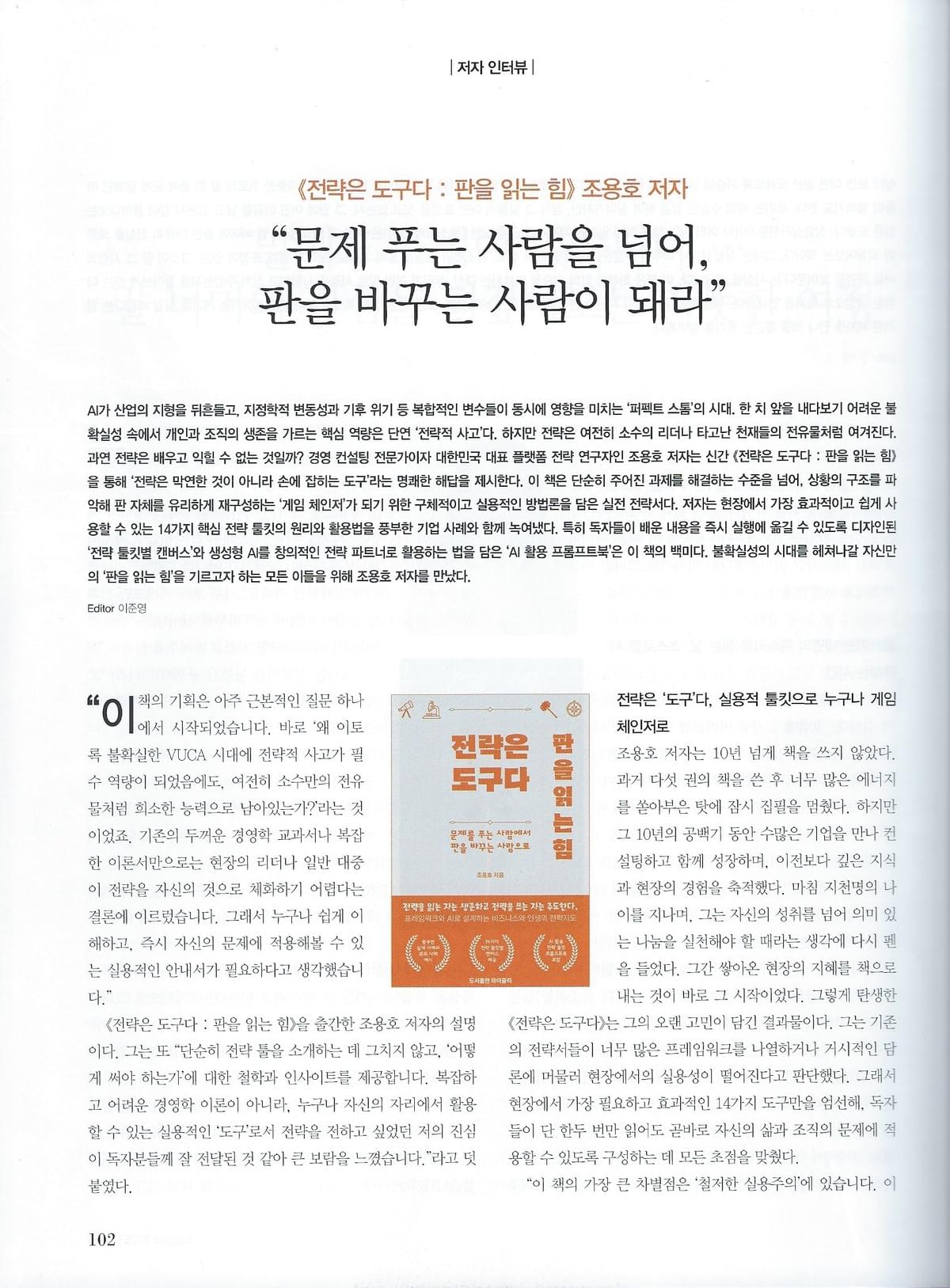
We live in an age of a “perfect storm,” in which AI is reshaping the industrial landscape while complex variables such as geopolitical volatility and the climate crisis exert their influence simultaneously. Amid uncertainty that makes even the immediate future hard to foresee, the defining capability for the survival of individuals and organizations is undoubtedly strategic thinking. Yet strategy is still regarded as the exclusive domain of a small number of leaders or naturally gifted geniuses. Is strategy really something that cannot be learned and mastered? In his new book Strategy Is a Tool: The Power to Read the Game, Brad Cho, a management consulting expert and one of Korea’s leading platform strategy researchers, offers a clear answer: strategy is not vague, but a tangible tool. This practical strategy guide presents concrete, useful methods for becoming a “game changer” who goes beyond solving assigned problems, grasps the structure of a situation, and favorably reshapes the game itself. Drawing on rich corporate examples, the author explains the principles and uses of the 14 core strategy toolkits that are most effective and easiest to use in practice. Two standout features are the “canvas for each strategy toolkit,” designed so readers can immediately put what they learn into action, and the “AI Prompt Book,” which shows how to use generative AI as a creative strategy partner. We met Brad Cho for everyone seeking to develop their own “power to read the game” and navigate an age of uncertainty.
Editor Lee Jun-young
Strategy Is a “Tool”: Practical Toolkits Can Make Anyone a Game Changer
“The concept for this book began with one fundamental question: ‘Why, even though strategic thinking has become an essential capability in this highly uncertain VUCA era, does it remain a rare ability treated as the preserve of a select few?’ I concluded that thick, conventional business textbooks and complex theoretical works make it difficult for leaders in the field or the general public to internalize strategy as their own. I therefore believed a practical guide was needed—one that anyone could understand easily and apply immediately to their own problems.”
This is how Brad Cho, author of Strategy Is a Tool: The Power to Read the Game, explains it. He added, “The book does more than introduce strategic tools; it provides a philosophy and insights into how they should be used. I wanted to convey strategy not as complex, difficult management theory, but as a practical ‘tool’ that anyone can use from where they stand. It has been deeply rewarding to feel that this sincerity has reached readers.”
Brad Cho had not written a book for more than ten years. After publishing five earlier books, he had expended so much energy that he paused his writing. During that ten-year gap, however, he met and consulted for numerous companies, grew alongside them, and accumulated deeper knowledge and field experience than before. Having passed the age of fifty, he felt it was time to move beyond personal achievement and practice meaningful sharing, so he picked up his pen again. Publishing the practical wisdom he had built up was the first step. Strategy Is a Tool emerged from this long reflection. He judged that existing strategy books listed too many frameworks or remained at the level of broad discourse, limiting their practical usefulness. He therefore selected only the 14 most necessary and effective tools from the field and focused entirely on structuring the book so readers could apply them to problems in their lives and organizations after just one or two readings.
“The book’s greatest distinction is its thoroughgoing pragmatism. To achieve this, I boldly discarded dry textbook explanations and wrote from a perspective that lets readers feel like explorers setting sail. Every strategic tool is accompanied by real examples from familiar companies to aid understanding. In particular, the book follows Minji, the protagonist of my earlier novel The Queen of Strategy, from beginning to end as she uses each tool to solve problems, enabling readers to build their ability to apply the tools naturally while immersed in the story.”
As he says, this book forms a set with its companion management novel, The Queen of Strategy. The intention is for readers first to become interested in strategy through an engaging story and then gain concrete tools and practical problem-solving capability. The carefully designed “dedicated canvases” and “AI-based prompts” that maximize the use of each tool are also powerful features unique to the book. The canvases help readers organize their thoughts visually and turn them into actionable plans, while the AI prompts use the latest technology to add efficiency and depth to strategy development. These are key devices that dramatically increase applicability in the field. Comparing today’s period of immense change to a tsunami, he emphasizes that leaders need a two-pronged mindset that combines offense and defense.
The Power to Abandon Your Own Perspective: Essential Reading for the “Generation That Moves the Game”
The readers who responded most enthusiastically after publication were men in their 30s, 40s, and 50s. Brad Cho calls them “the generation that moves Korea’s game.” As organizational leaders, company heads, and experts in their fields, they experience the greatest urgency to “read the game” every day on fiercely competitive business front lines, and therefore resonate deeply with the book’s message.
“One reader commented that ‘the ultimate goal of this book is to democratize strategic thinking,’ and I was delighted that they had understood my intention precisely. Another wrote that ‘the book helps readers go beyond surviving by reading the game and develop the ability to devise new strategies and take the lead in shaping it.’ That aligned exactly with my hope that the book would become more than a crisis-management manual: a guide for leaders shaping the future.”
Fortunately, many readers accurately grasped the core of the author’s question about “democratizing strategy.” He believes the book’s true core audience is not a particular age group, but everyone facing a “strategic inflection point” in life or business: an employee in their 30s leading a team for the first time, a startup founder risking everything to enter a new market, or a university student preparing for the future by interpreting a complex world through frameworks. The book belongs to everyone with the desire to read and redraw the “game” of their own life and business. He stresses that the AI era makes habits that strengthen uniquely human cognitive abilities even more important. Outsourcing even our thinking to AI, he says, creates a debt that will eventually return like a boomerang.
“I believe that outsourcing intelligence, perspective, and decision-making capacity in the AI era creates a debt that will ultimately return like a boomerang. I hope people develop their own perspective—especially a strategic perspective and tools for the VUCA era—and make these their own weapons, developing their capabilities as proactive actors rather than passive followers and ultimately choosing the path toward happy organizations and lives.”
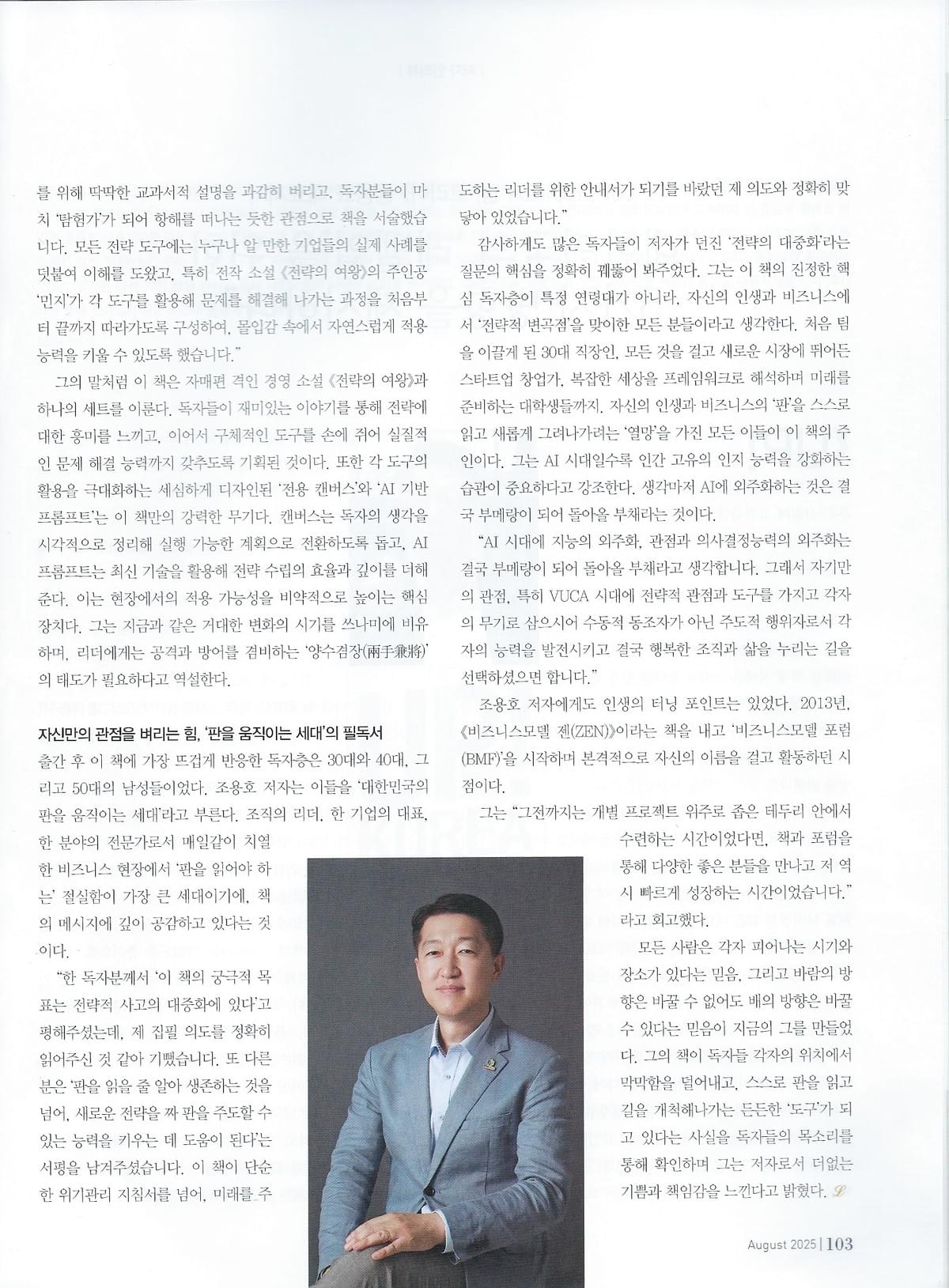
Brad Cho also had a turning point in his life. It came in 2013, when he published Business Model Zen and launched the Business Model Forum (BMF), beginning in earnest to work under his own name.
He recalled, “Before that, I had spent my time training within the narrow boundaries of individual projects. Through the book and forum, I met many wonderful people, and I too grew rapidly.”
He said that what made him who he is today was the belief that everyone has their own time and place to bloom, and that although we cannot change the direction of the wind, we can change the direction of the ship. Hearing readers say that his book has become a dependable “tool” that relieves uncertainty and helps them read the game and forge a path from wherever they stand brings him unsurpassed joy and a sense of responsibility as an author.