Written by Brad Cho, The Innovation Lab
This year, the world experienced the wholly unforeseen global event of the COVID-19 pandemic, leaving businesses and households burdened by sluggish sales, reduced income, and growing debt. On the opportunity side, however, it has acted as a catalyst accelerating digital transformation, and it is now common to hear that changes once expected to take five years are happening within one.
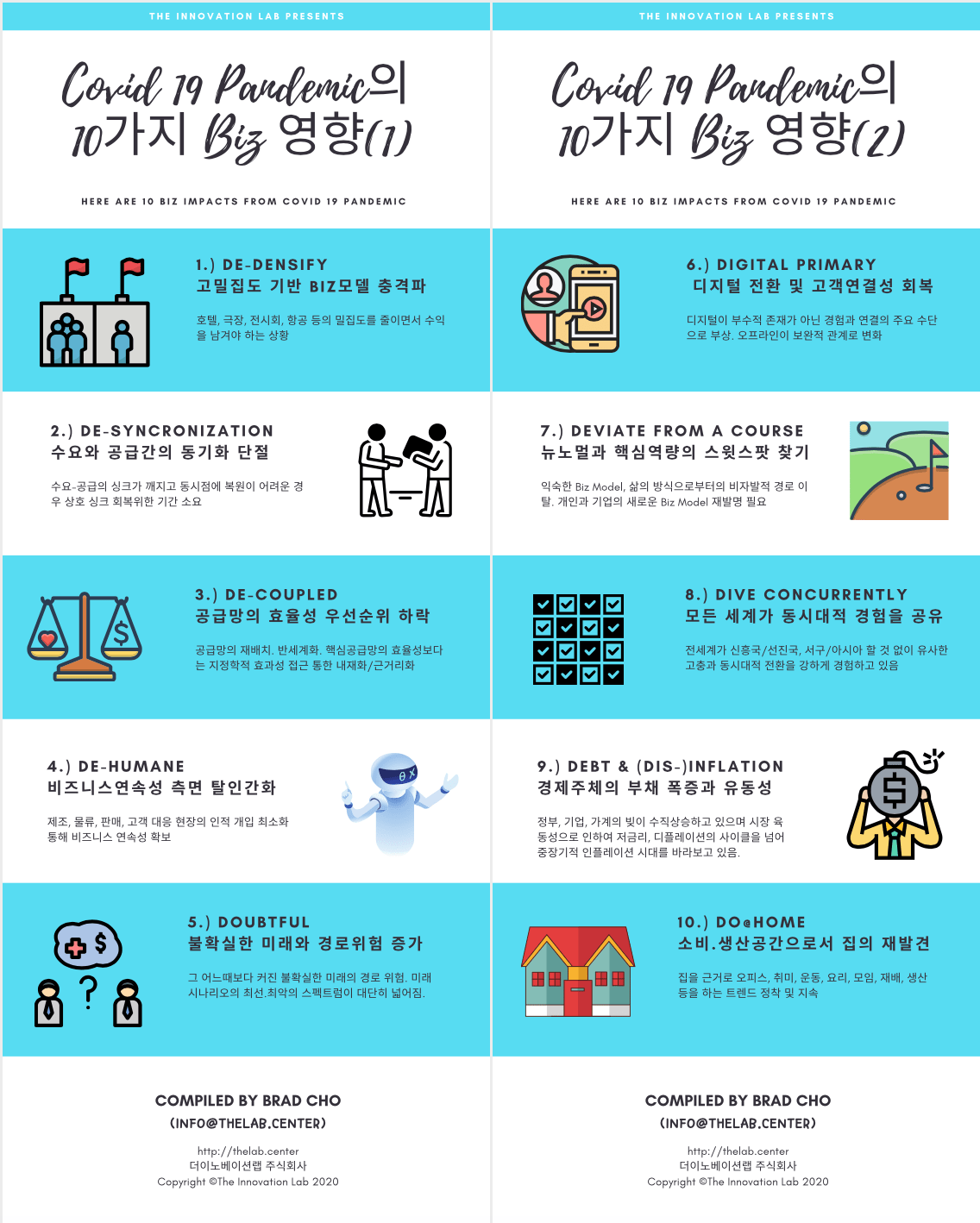
Before the year ends, it is worth taking stock of how the pandemic is affecting the business environment and how we need to respond. Here, I have organized its impacts into 10 categories.
1) De-Densify (Shock to high-density business models)
Social distancing intended to prevent the spread of the virus is being implemented both voluntarily by the private sector and through government mandates. Business models built around a certain level of density are seeing profitability deteriorate as revenue falls while fixed costs remain unchanged. The sectors most visibly affected include hotels, cinemas, exhibitions and performances, travel, and aviation. Hotels are gradually recovering toward previous levels, but inbound and outbound tourism and international aviation still appear to have a long way to go.
2) De-Synchronization (Breakdown in synchronization between supply and demand)
The connection between supply and demand is usually based on the expectation that buyers and suppliers will meet at a particular place and time and satisfy one another’s needs. The pandemic, however, has created mismatches in these expectations and connections.
From a consumer’s perspective, a favorite shop may be closed during normal business hours or temporarily shut down because of government social-distancing policies. Conversely, a shop may reopen after a long closure, but consumers may not realize it and take some time to return. From a company’s perspective, the more ways it has to communicate proactively with customers through email, KakaoTalk, or SMS, the easier it may be to overcome these expectation mismatches.
3) De-Coupled (Declining priority of supply-chain efficiency)
A fundamental reason the global boom lasted for more than a decade after the 2008 U.S. financial crisis was a mutually beneficial global trade and financial structure: massive U.S. quantitative easing, including money creation, and China’s industrial development enabled the United States to buy Chinese goods while China bought U.S. Treasury securities. It could also be described as a decade in which the United States exported inflation by printing money while China exported deflation by manufacturing goods cheaply.
Global multinationals prioritized supply-chain efficiency, placing production bases in China and consumer markets in the United States and Europe to expand profits. China’s GDP relative to that of the United States grew from 10% in 2000 to 40% in 2008 and 68% in 2020, reaching a level at which the United States could clearly feel China threatening its position as the hegemonic power. While China, where the pandemic originated, is still recording GDP growth this year, the United States, the hardest-hit country, is experiencing negative GDP growth, further accelerating China’s economic catch-up.
The United States is therefore pressuring companies to reorganize supply chains around geopolitical effectiveness rather than efficiency, while strengthening reshoring incentives and trade barriers to bring production back home. Recently, it has also sought to raise barriers in capital markets by tightening accounting standards for Chinese companies listed in the United States.
We have thus reached an inflection point from a G2 world in which the United States and China coexisted toward a G0 world as U.S. leadership in the international community weakens. Companies doing business overseas in particular will need to examine carefully how this geopolitical context affects their business environment.
4) De-Humane (Dehumanization for business continuity)
South Korea has one of the world’s highest rates of industrial-robot adoption. This has been driven by a rigid employment structure and high wages, among other factors, but the pandemic has brought fresh momentum not only to industrial robots but also to the service-robot market. Whereas robots in the past focused on mass-production systems and manufacturing efficiency, they are likely to become an essential means of ensuring business continuity.
This is because various industries that have had to close production lines or offices temporarily after confirmed cases are considering robots, AI, and RPA as part of systems that can protect essential operations from the virus. The trend is visible not only in self-checkout kiosks, serving robots, and robot baristas, but also in smart ordering at highway service areas under a recent agreement between the road management corporation and NAVER.
5) Doubtful (Greater uncertainty about the future and pathway risks)
Companies commonly use scenario planning to develop future scenarios and consider response strategies. These will include Worst and Best scenarios. The pandemic has become a factor with a profound effect on scenario development. Uncertainty about the future is high: when will vaccination establish herd immunity and end the pandemic, and might other variables emerge in the meantime, such as new variants or vaccine side effects?
When uncertainty is high, companies postpone investment and households restrain consumption and focus on saving. Neither helps economic recovery. Fortunately, Pfizer, Moderna, and others reported positive Phase 3 clinical-trial news in mid-November, raising expectations for vaccine use. Full-scale vaccination will probably begin in countries such as the United States in January or February next year. Because South Korea has relatively fewer confirmed cases than countries such as the United States, full-scale vaccination there will likely begin around June next year after observing side effects following vaccination overseas.
We can then hope that herd-immunity levels will be reached around the end of next year and that the economy will gradually emerge from the pandemic’s effects.
6) Digital Primary (Digital transformation and restored customer connectivity)
In the past, businesses were divided into digital-first and offline-first businesses, while large offline-centered companies prepared for digital transformation. Now, digital transformation has become an immediate survival issue for companies large and small alike. Offline location-based businesses that have lost customer connectivity—department stores, high-street shops, restaurant franchises, and theme parks—are fading. Meanwhile, digital models such as online streaming, subscription services, personalized curation, live commerce, and indie brands are gaining attention by addressing fragmented customer needs through data-driven AI and logistics innovations such as delivery, early-morning delivery, and fresh-food logistics.
This trend appears to be becoming mainstream as digitally fluent MZ consumers—Millennials and Generation Z—emerge as the core of consumption. Online and digital channels once merely supplemented offline channels; survival now depends on rapidly shifting to a structure in which online and digital are primary and offline plays a supporting role.
During this process, many offline-based businesses have reassigned employees or offered voluntary retirement, and this looks likely to continue through next year as companies change their business structures.
7) Deviate from a course (Finding the sweet spot between the new normal and core capabilities)
Every company has a business model. The problem is that it is not a business model designed with the pandemic in mind. The pandemic is challenging companies in many areas, including customer relationships and migration to digital channels. Rather than interpreting these changes as temporary—a single high wave to shelter from briefly—it seems more accurate to see them as a wildfire whose flames flare up here and there even after it appears extinguished.
In particular, two major effects will persist in the economy and business environment even after the pandemic passes.
First, debt has risen substantially among all three economic actors: government, companies, and households. Governments increased debt to fund disaster relief and unemployment benefits; companies issued corporate bonds to stabilize operations; and households borrowed for living expenses and investment. This suggests that the shock will be far from small when interest rates eventually rise.
Second, the habits of consumers—and companies—have changed. Assuming current conditions persist from February this year until the middle or end of next year, consumers and companies will have lived in the changed environment for more than 18 months.
That is long enough for temporary behavior to become habitual. Even after the pandemic, the companies most likely to win customers will be those that studied consumers’ changing habits during the pandemic and worked to resolve their difficulties.
8) Dive Concurrently (Every generation shares the same contemporary experience)
The pandemic does not mean crisis alone. How many times in a century does an event cause every generation worldwide to share the same experience? The pandemic has brought health risks and economic and everyday inconvenience to many people, but it has also created an opportunity: an enormous market united by a common experience.
Frequent mask wearing causes skin irritation through contact, and conventional cosmetics can rub off onto masks. Companies that solve these problems have produced bestsellers. Likewise, the growing desire to sleep and rest apart from others even while traveling has created opportunities for car-camping products.
Beyond Zoom’s rapid growth by enabling remote meetings, online services that replace essentials of traditional offline meetings—sticky notes, whiteboards, and large sheets of paper—are encountering unprecedented demand. If companies can study and effectively solve new customer difficulties created by the pandemic, they can build a viable business for a global market.
9) Debt & (Dis-) Inflation (Surging debt and liquidity among economic actors)
As noted above, debt among economic actors has surged, but the volume of money issued by the world’s major central banks is especially striking. The United States has responded to the pandemic by creating new money equivalent to more than 20% of GDP. Once power transfers to the Biden administration, another massive supply of dollars is expected to fulfill campaign commitments such as the Green New Deal.
This is increasing global liquidity, raising asset prices, and lowering the dollar’s value. In South Korea, the falling dollar has conversely strengthened the won, creating some pressure for exporters. Central-bank policy rates appear likely to remain unchanged through the end of next year, but the movement of market rates based on government-bond yields warrants close attention. Bond yields generally rise as inflation expectations increase, and those expectations are already strengthening following November’s vaccine-development news and the election of a U.S. Democratic president comfortable with monetary expansion.
Issuing large volumes of government bonds to finance economic stimulus will tend to push bond yields higher. We are now entering a stage that requires solving a complex equation: controlling market liquidity so it does not produce inflation while issuing government bonds at low rates. Unless a double-dip recession occurs as some fear, market interest rates are therefore likely to begin rising by the middle or end of next year at the latest, and preparations will be necessary.
10) Do@Home (Rediscovering the home as a space for consumption and production)
The home was generally understood primarily as a living space where people rested while attending work and school. Products whose demand has risen sharply during this pandemic include large-screen TVs, high-performance laptops including webcams, furniture including desks, beds, and content services such as Netflix. This reflects the home’s rediscovered use as a space for consumption and production as people work remotely and attend classes there.
In the United States, where the pandemic has been severe, demand has also increased for moves from small urban homes to larger homes in suburban areas with easier access to nature. As family members spend much more time together at home, they need both individual and shared spaces. More remote work also eases the burden of commuting, eliminating the former need to live close to the workplace. This redefined role for the home has created demand for a wide range of offerings—for example, ways to pursue hobbies, exercise, cook, and socialize while staying home.
In fitness, smart home-training services such as Peloton and Mirror, which connect people with coaches for live group training, are attracting attention.
That concludes this summary of 10 business impacts of the pandemic. From the perspective of social ventures, how should these changes ultimately be understood and addressed proactively? Compared with startups in general, social ventures are more often offline- or locally based and active in travel, space, community, and education.
This is because social ventures relatively often have the characteristics of low-tech rather than high-tech businesses, and service ventures rather than technology ventures. This suggests that social ventures may have been more directly affected by the pandemic.
Pandemic threats
- Greater debt burden
- Weaker connectivity with offline customers
- Restrictions on movement between people
- Constraints on gathering in shared spaces
- Restrained consumption and increased saving
- Global economic contraction
- Loss of offline customers
- Consumption and production at home
- Changed consumer behavior (habits)
Pandemic opportunities
- High liquidity based on low interest rates
- Stronger digital customer connectivity
- Growth in online activities
- Delivery, pickup, and takeout become routine
- Revenge spending (increased deferred consumption after the pandemic)
- Emergence of a global market united by a shared experience
- Rise of the MZ generations (digitally friendly consumers)
- Consumption and production at home
- Changed consumer behavior (habits)
Yet, just as the word crisis is said to combine threat and opportunity, the pandemic also presents a face of opportunity to social ventures. The table above briefly lists several pandemic threats and opportunities. Almost every threat can be matched one-to-one with an opportunity when viewed from another angle. Changed consumer behavior (habits), in particular, is itself both a threat and an opportunity.
It is said that after losing his son in an accident and falling into despair, Biden, who became president of the United States, found an insight in a two-panel cartoon that helped him emerge from grief. In the cartoon, a man cries out to God, ‘Why Me (why have you given this ordeal specifically to me)?’ A voice from heaven responds, ‘Why Not (why shouldn’t it be you)?’
The pandemic is unquestionably a major event that has set companies the task of ensuring their very survival, and social ventures that solve social problems through positive impact are no exception. Yet this is precisely the moment when we most need profound wisdom and steadfast courage: to accept the situation as it is and turn yesterday’s threats into tomorrow’s opportunities.
End.