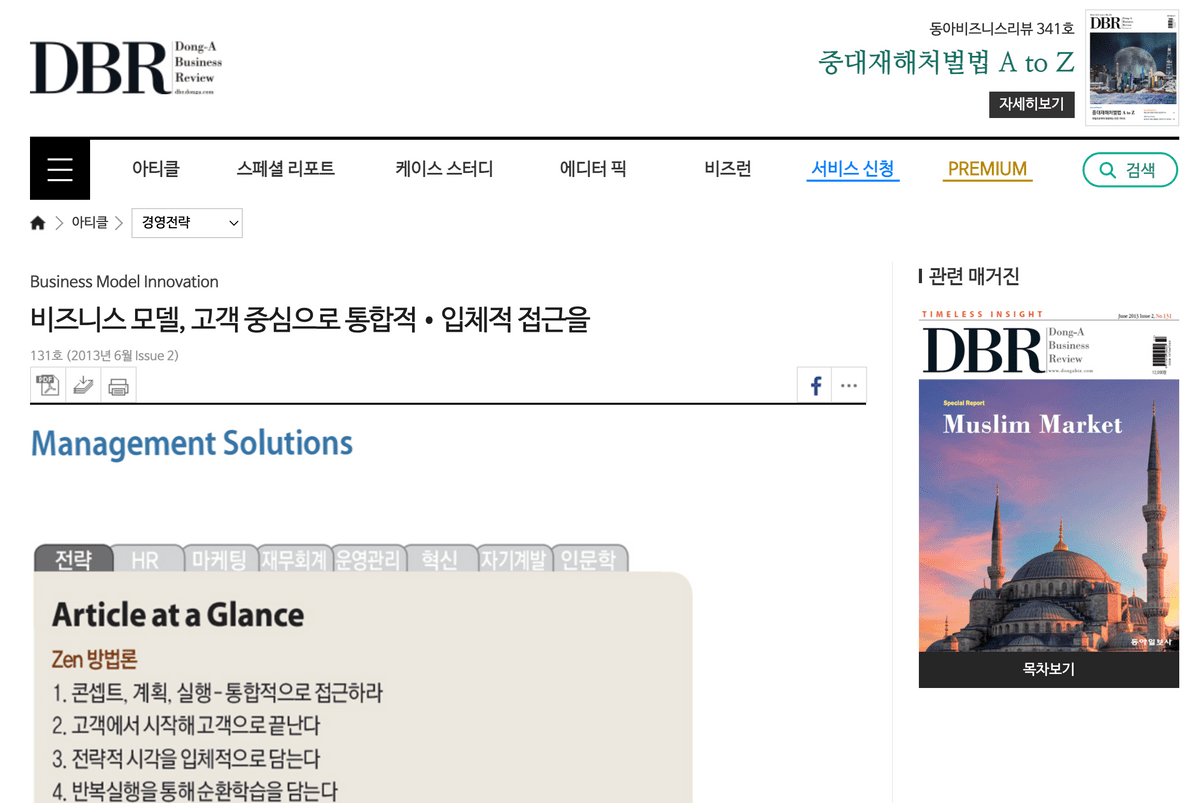
Only a customer-centric approach can differentiate a business model—
‘ZEN’: An Integrated Methodology for Building Business Models
Yongho Cho, CEO of Vision Arena brad.cho@visionarena.co.kr
<About the Author>
The author graduated from Dongguk University’s Department of Industrial Engineering and earned an MBA from Finland’s Aalto University School of Business. He has served as an advisor on government ICT industry policy and as an adjunct professor at Hanyang University. At Oracle Korea, Samil PwC, and other firms, he spent more than 10 years consulting on new e-business and mobile ventures and technology strategy. In 2010, he founded Vision Arena Co., Ltd. (visionarena.co.kr), a management consultancy specializing in platform strategy and business models, and currently serves as its principal consultant.
The ZEN Methodology
- Take an integrated approach to concept, planning, and execution
- Start with the customer and end with the customer
- Incorporate a multidimensional strategic perspective
- Build in iterative learning through repeated execution
- Use existing innovation methodologies in an integrated way
- Assess the attractiveness of the business model
- Turn the business model into a cube

Why Business Model ZEN?
New business models have become a major topic for companies. Why are companies so interested in business models? Because a business model contains a concrete design aligned with the purpose of doing business. In this sense, a business model lays out a company’s business choices (Choice) and the relationships among them: how it will create and deliver customer value and then monetize it. Several years ago, while coaching a professional training program for service planners for about a year, I taught a methodology that was unfamiliar at the time but is now reasonably well known. One realization I had then was that a business model is subordinate to its concept. Moreover, as the recent Lean Startup movement shows, the success of a business model is not a matter of concepts but of practice—continually narrowing the gap with the market.
I would like to introduce Business Model ZEN, a methodology for building business models developed through research based on a range of prior studies and my own experience. First, the name requires a brief explanation. ZEN signifies unity, harmony, and minimalism in an Eastern sense. These are the qualities this methodology seeks to embody. When choosing the name, I considered Tao and Zen, both familiar to the public. I ultimately chose Zen because the term, referring to the Japanese tradition, was found to evoke an image closer to minimalism. <remainder omitted>